This is some text inside of a div block.
Search across the whole Roadsides site


Marketplaces are one of the few sites left for shopping where the underlying spatial and material infrastructures encourage and facilitate us to physically and materially encounter unfamiliar people rather than only products. As the devices and technologies of online and offline retailers calculate our actions more ‘efficiently’ towards sales (Cochoy 2008), it becomes more rare, more of a purposefully inefficient experiential activity, to spend—and waste—time in a marketplace. Markets like er-Rahba el-Qadima (الرحبة القديمة), in Marrakech, become sites that attract tourist visitors by providing a ‘traditional’ or ‘local’ cultural experience of shopping (whether or not ‘locals’ actually shop there). They represent a classic form of a particular type of economic encounter that involves extended, face-to-face, embodied interaction between buyer and seller, and the many others passing by. They are spaces where buyers and sellers are invited to interactionally make subtle assessments and decisions about the quality and value of goods being exchanged because they are traded between people in conversation, who can invoke their social categories and relationships in transacting with each other.
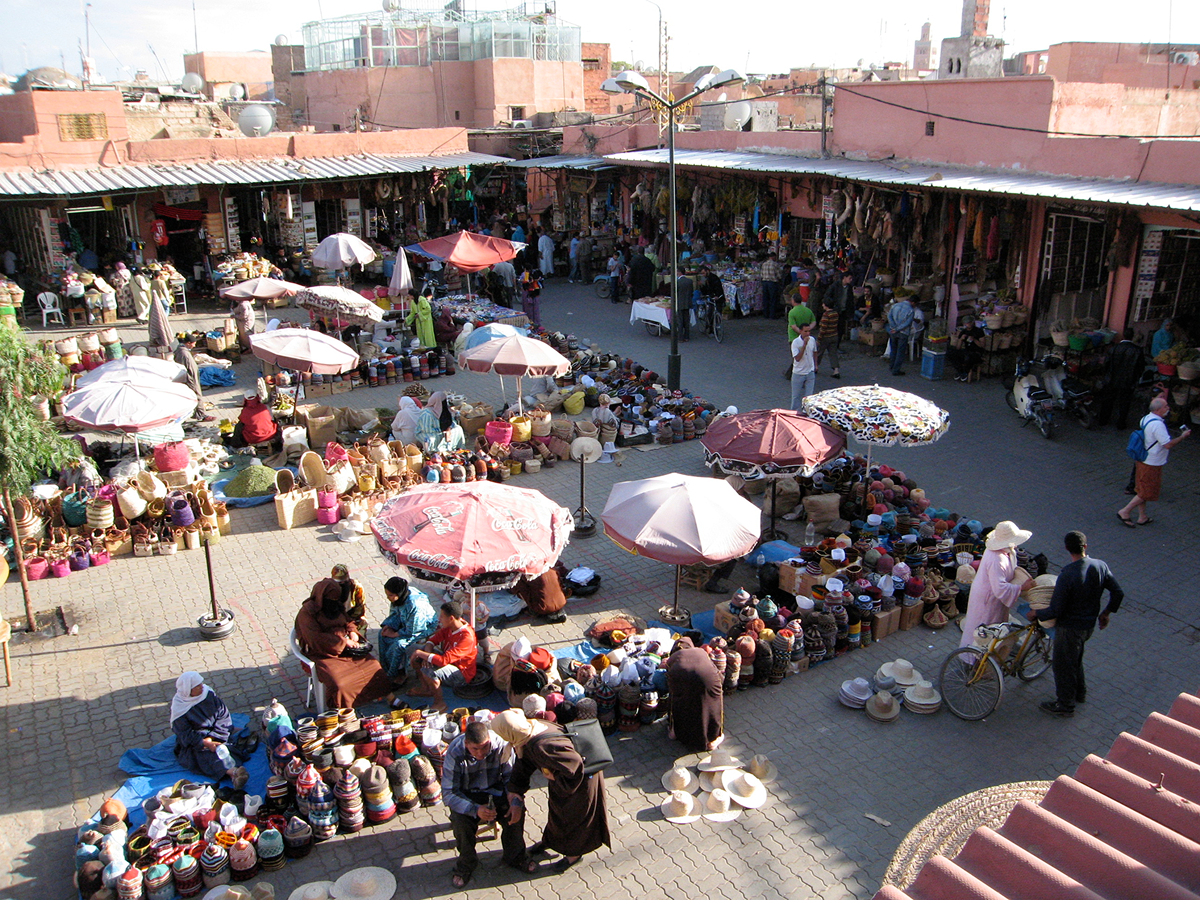
Yet the experience of being present and interacting with others offered by ordinary marketplaces is not only for tourists; urban planners recognize how valuable marketplaces are for making cities inclusive and vibrant for their citizens, both socially and economically. The rhythms and buzz (Coles 2014) of markets enable them to take up affective space that exceeds their physical footprint, generating an atmosphere that draws people in and perpetuates its vitality through their co-present activity.
The physical openness of marketplaces in central urban public spaces makes them (at least in principle) accessible to all possible users, regardless of social categorizations or economic barriers. In this sense, markets are sites of constant mobility, even while being fixed in place, through the way they are accessed by residents and newcomers—transient users and regular ones—as well as being a place where flows of goods move into and through a locality following licensed and unlicensed channels, depending on the structures of control that govern a market’s use (van Eck et al. 2022). While there can be significant ways that marketplaces reiterate inequalities of the city structures in which they are embedded (Aptekar 2019), the multifacetedness of public space offers chances for improvisation which are more constrained in privatized commercial environments designed for consumption.
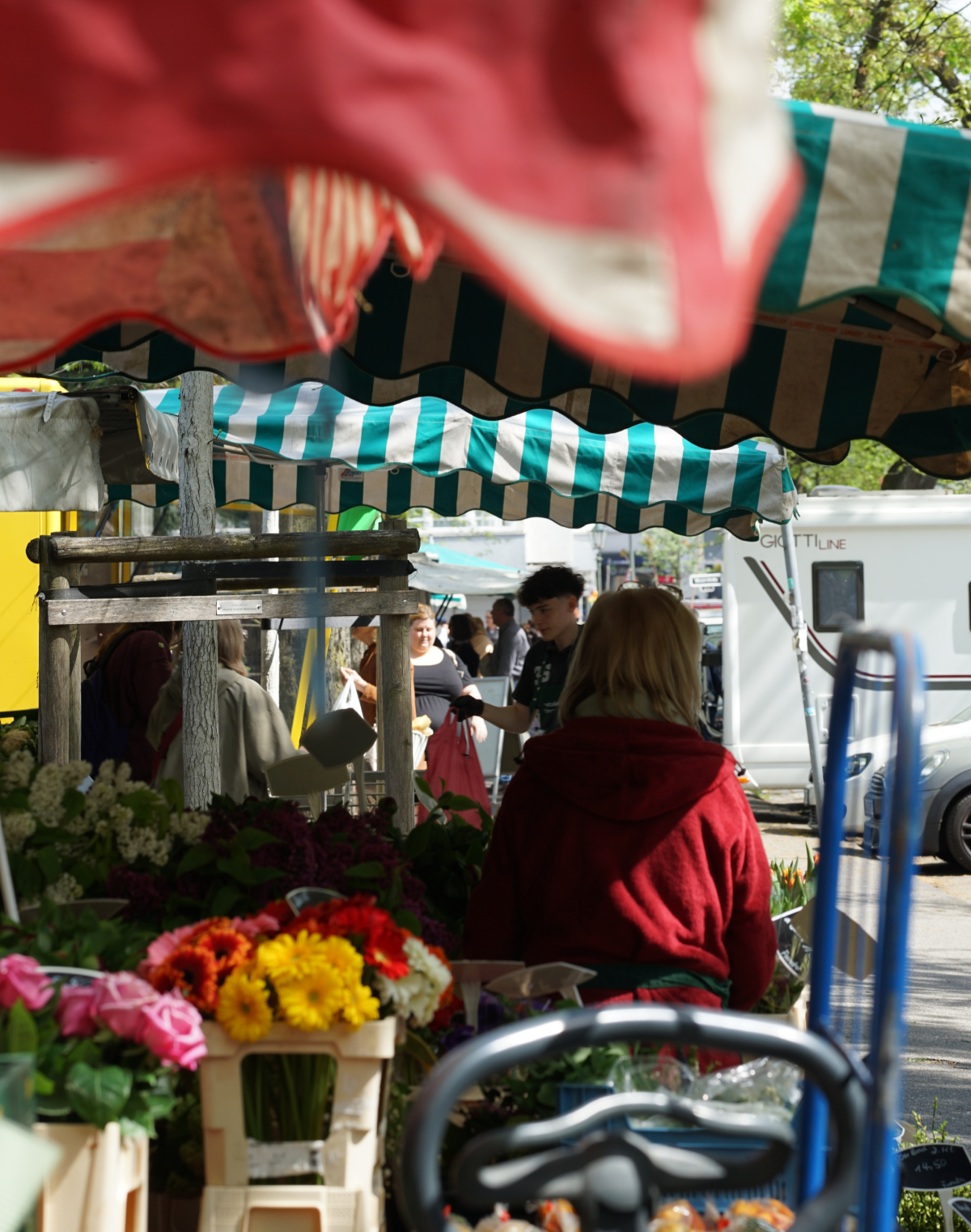
I contend that the complexity of these malleable and embodied features of marketplace interactions produces a kind of “social infrastructure” (Layton and Latham 2026), meaning a time and space that facilitates citizens forming connections to each other beyond their family or working lives, while making use of spatial resources that are shared and structurally accessible. This layered complexity of physical, social and economic interactions is what makes markets buzz, or what it is that they offer as a space of encounter which infrastructures them as socially vibrant in ways that differ from other modes of economic transaction.
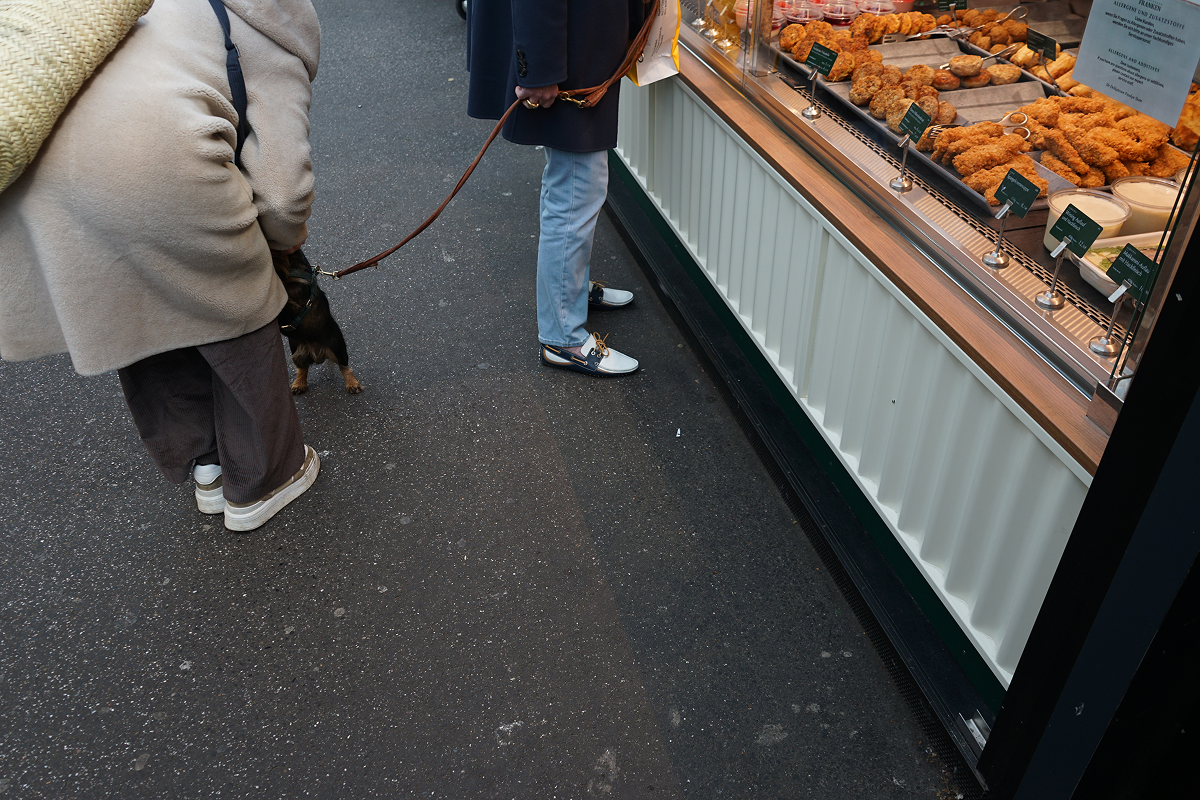
To investigate how their complexity works—how the buzz is produced—I advocate for ethnomethodology and conversation analysis (EMCA), which attends particularly to the ways social life is generated through the communicative and embodied detail of human interactions. The magical features of markets that others have identified—like the frisson of bumping along with others (Watson 2009)—are what we can examine more closely using EMCA approaches, to try to understand what moments and actions in encounters with others generate our orientations to markets as social environments. In its mechanics, EMCA research allows us to closely examine a moment like that in the image below, of engaging with a stranger’s dog, to recognize how the participants involved co-produce the emergent social reality of their interaction and the space in which it occurs.
If you are lucky enough to have a market nearby for food, clothes, antiques, spices, shoes or junk, you may recognize the complexity of a market’s buzz. Your market may well be the place where you have the most substantive interactions with strangers over a given week of your life. By interactions, I do not only mean talking to people; I also mean observing their fashion, style and behavior, and being observed oneself; sharing sensory experiences of sounds, smells and touch with other people and with the material variety of goods on offer; and navigating space with, against and through the people and physical arrangements that contour a market’s mobilities. We can see, hear, smell, taste, as well as converse with others, in ways that make our encounters more complex rather than more efficient.
All of these engagements—as well as the opportunities marketplaces offer for more extended conversations through face-to-face transactions—contribute to the invaluable, and sometimes invisible, ways that we learn practices for embodied interaction for being present in public space and engaging with unfamiliar others. Though we become more skilled at it over time, EMCA research shows how it takes work to learn how to move along with and avoid crashing into others as you walk on crowded paths in public space (Mondada 2014), just as waiting in line, or queuing, requires contextual knowledge and sensorily embodied skill to perform successfully (Ayaß 2020). Depending on where you are in the world, touching and smelling the fruit and vegetables or tasting the cheese (Mondada 2019) may be a key part of making your market selections, or may not be allowed in order to protect the quality and hygiene of the offer.
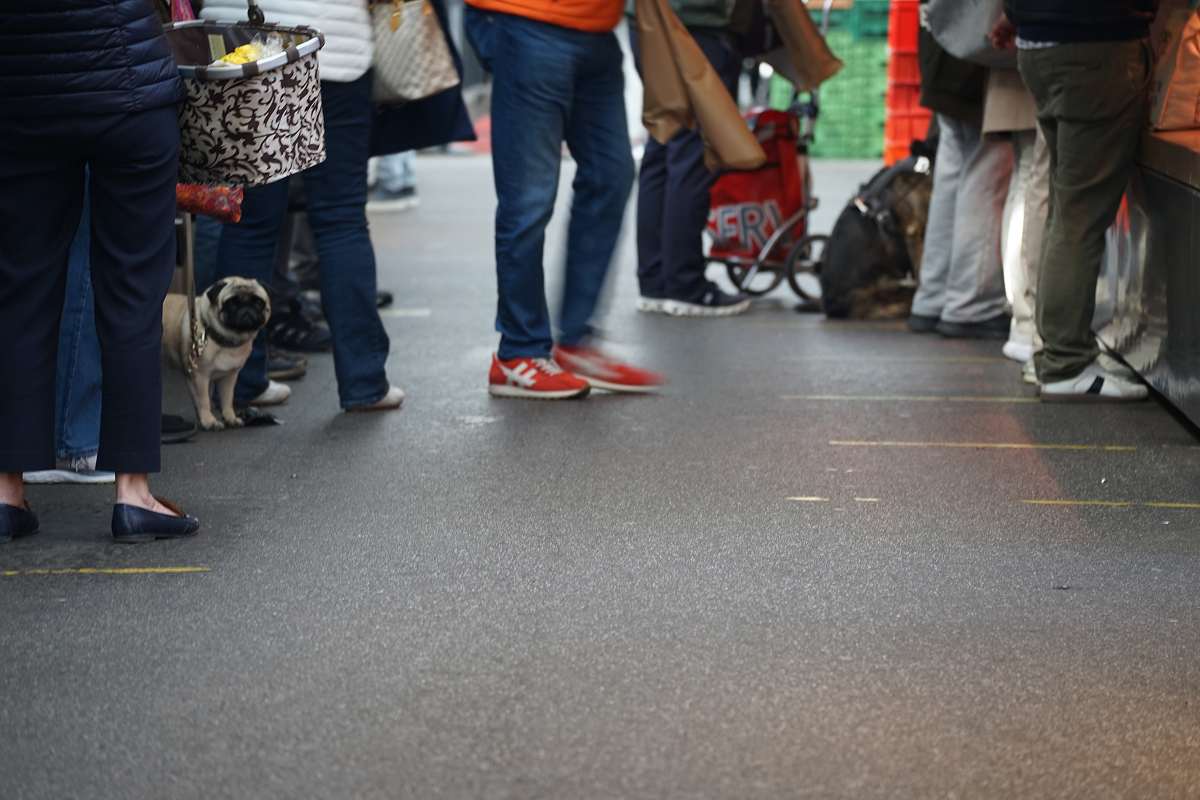
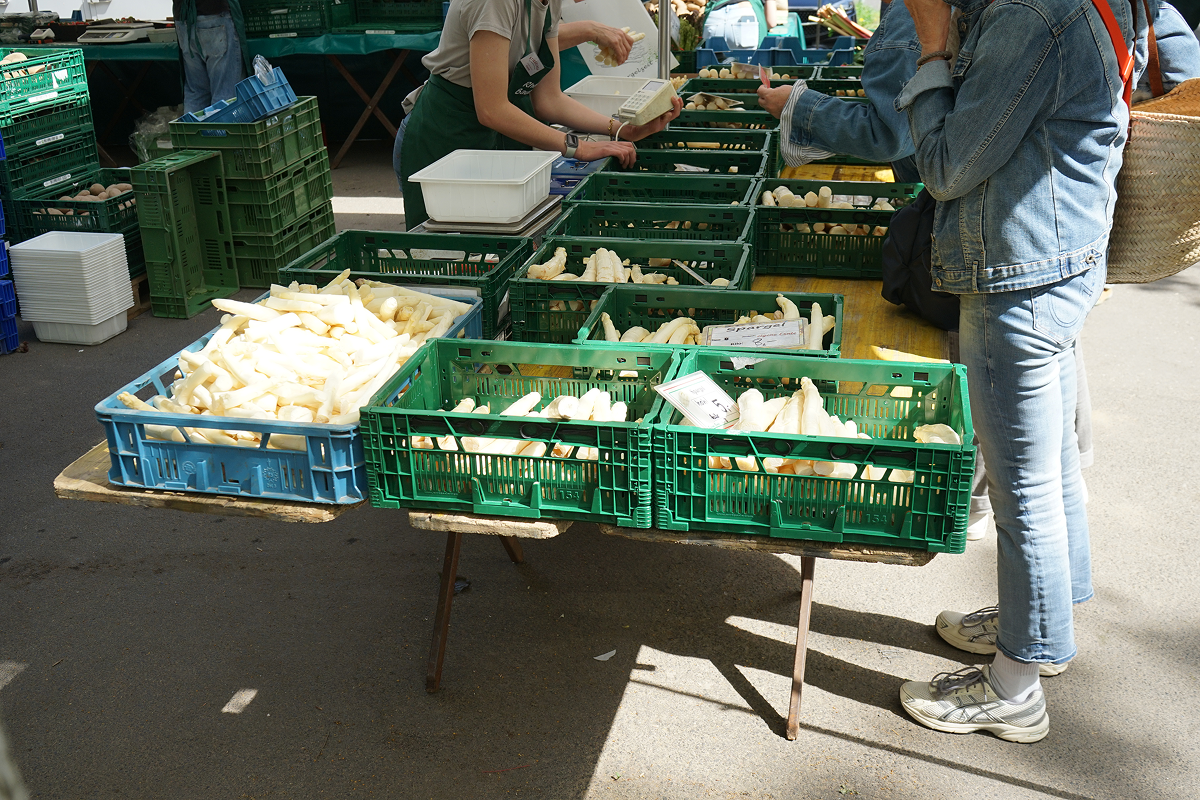
Such rules of embodiment and interaction are part of what we absorb into practice by being in public marketplaces where the processes of buying and selling take place through extended and sometimes awkward social interaction, rather than through technologically-mediated efficiency. Counting out change into someone’s hand—a more inaccurate, less hygienic, more tactile technology of payment than contactless banking transmission—generates scope for extending such interactions and potentially forming richer connections between interlocutors. It is in the time allowed by these activities where hospitable exchanges happen (Brown and Laurier 2014). We need time to get to know each other and grow accustomed to how we inhabit shared space together, especially if we want to go beyond considering each other through presumptive categorizations (Wagner 2024). The inefficiency of marketplaces is precisely how they infrastructure sociality, through the capacity to spend time evaluating, comparing, selecting, debating—and even sometimes being rewarded for the effort. My own children receive a weekly bonus for going to our local market, in the form of little giveaways offered by vendors to young kids who have endured waiting for the transaction to finish. Our local supermarket has a parallel offer—a bin of fruit waiting for “young shoppers”—but those items are not handed to them by an individual looking into their eyes, offering a gift and receiving a thank you.
Of course, these interactions have the potential to evolve into more negative categorizations of others. In my research on marketplace bargaining in diasporic contexts in Morocco, I have shown how buyers and vendors might be talking about the price of goods while interactionally invoking their claim to social categorizations, trying to establish how they belong in a complex landscape of in-groups and out-groups (Wagner 2015). Though buyers may use arguments of economic rationality about the costs of transport or quality of a good, doing so can destroy the substance of the trading relationship by fundamentally ignoring or inadvertently diminishing the social and economic standing of the vendor. Missing even small signals about constructing politeness and acknowledging the other can bloom into larger stereotypes and categorizations of being different that are hard to pin down or contradict (Wagner 2021). Yet, even after disagreeing to the point that no sale could be made, conversations would often end with what conversation analysts refer to as repair (Albert and de Ruiter 2018): interactional work on both sides to acknowledge difference, apologize or excuse, and potentially followed by getting to know each other through small talk. A failed sale did not equate to a ruptured relationship. Rather, the time spent working together, interactionally, on making a sale happen provided opportunities to generate trust in more complex and interpersonal ways.
I contend that these multilayered embodied encounters are a crucial social infrastructure enabled by marketplaces. Perhaps without recognizing it as such, I suspect we seek out these experiences when we travel to other places and count visiting a market as a touristic activity; we are looking for the frisson of co-presence and embodied experience of unexpected interactions at the market, beyond simply the goods on offer. Marketplaces exceed the space that they take up in cities because of their potential for inefficient economic exchange, along with all the other activity, atmosphere and embodied encounters that such inefficiency produces.
Fox, Barbara, Lorenza Mondada and Marja-Leena Sorjonen (eds.). 2023. Encounters at the Counter: The Organization of Shop Interactions. Studies in Interactional Sociolinguistics. Cambridge University Press.
Haddington, Pentti, Tiina Eilittä, Antti Kamunen, Laura Kohonen-Aho, Iira Rautiainen and Anna Vatanen (eds.). 2023. Complexity of Interaction: Studies in Multimodal Conversation Analysis. Springer Nature.
Kerbrat-Orecchioni, Catherine and Véronique Traverso (eds.). 2008. Les interactions en site commercial: Invariants et variations. Langages. ENS Éditions. https://doi.org/10.4000/books.enseditions.30980
Layton, Jack and Alan Latham (eds.). 2026. Social Infrastructure in Neighbourhoods and Cities: Studying the Facilities That Sustain Community, Social Networks, and Trust. Bristol University Press.
Rasmussen, Gitte and Theo van Leeuwen (eds.). 2023. Multimodality and Social Interaction in Online and Offline Shopping. Routledge. https://doi.org/10.4324/9781003284123
Sezer, Ceren and Rianne van Melik (eds.). 2023. Marketplaces: Movements, Representations and Practices. Routledge.
Watson, Sophie and Davis Studdert. 2007. Markets as Sites for Social Interaction: Spaces of Diversity. Policy Press.
Albert, Saul and J. P. de Ruiter. 2018. “Repair: The Interface Between Interaction and Cognition.” Topics in Cognitive Science 10 (2): 279–313. https://doi.org/10.1111/tops.12339
Aptekar, Sofya. 2019. “The Unbearable Lightness of the Cosmopolitan Canopy: Accomplishment of Diversity at an Urban Farmers Market.” City & Community 18 (1): 71–87.
Ayaß, Ruth. 2020. “Doing Waiting: An Ethnomethodological Analysis.” Journal of Contemporary Ethnography 49 (4): 419–55.
Brown, Barry and Eric Laurier. 2014. “Word of Mouth: Products, Conversations and Consumption.” Consumption Markets & Culture 17 (1): 29–49.
Cochoy, Franck. 2008. “Calculation, Qualculation, Calqulation: Shopping Cart Arithmetic, Equipped Cognition and the Clustered Consumer.” Marketing Theory 8 (1): 15–44.
Coles, Benjamin F. 2014. “Making the Market Place: A Topography of Borough Market, London.” Cultural Geographies 21 (3): 515–23.
Layton, Jack and Alan Latham (eds.). 2026. Social Infrastructure in Neighbourhoods and Cities: Studying the Facilities That Sustain Community, Social Networks, and Trust. Bristol University Press.
Mondada, Lorenza. 2019. “Contemporary Issues in Conversation Analysis: Embodiment and Materiality, Multimodality and Multisensoriality in Social Interaction.” Journal of Pragmatics, Quo Vadis, Pragmatics? 145 (May): 47–62.
Mondada, Lorenza. 2014. “Bodies in Action: Multimodal Analysis of Walking and Talking.” Language and Dialogue 4 (3): 357–403.
van Eck, Emil, Sophie Watson, Rianne van Melik, Markus Breines, Janine Dahinden, Gunvor Jónsson, Maria Lindmäe, Marco Madella, Joanna Menet and Joris Schapendonk. 2022. “Moving Marketplaces: Understanding Public Space from a Relational Mobility Perspective.” Cities 127 (August): 103721. https://doi.org/10.1016/j.cities.2022.103721
Wagner, Lauren. 2024. “Encounters in Motion: Being Present with Others in Long Duration Train Travel.” Mobility Humanities 3 (2): 45–75. https://doi.org/10.23090/MH.2024.07.3.2.004
Wagner, Lauren. 2021. “‘Smelling’ Diasporic: Bargaining Interactions and the Problem of Politeness.” Applied Linguistics Review 14 (5): 1085-107.
Wagner, Lauren. 2015. “‘Tourist Price’ and Diasporic Visitors: Negotiating the Value of Descent.” Valuation Studies 3 (2): 119–48. https://doi.org/10.3384/VS.2001-5992.1532119
Watson, Sophie. 2009. “The Magic of the Marketplace: Sociality in a Neglected Public Space.” Urban Studies 46 (8): 1577–91.
I owe a debt of gratitude to the colleagues who participated in the International Workshop on Economic Encounters nearly a decade ago in Maastricht. Special thanks and large debts are due to Brian Due, Eric Laurier and Lorenza Mondada for their collaborative work on a paper which never saw the light of day. Their research, along with many others from the workshop and beyond, shows how much of our communicative, social and embodied resources go in to building quotidian economic interactions.
The Dusseldorf photographs are part of the Maastricht University BSc Global Studies thesis research performed by Luis Frank on social infrastructures in food shopping. Many thanks to Luis for his hard work and permission to integrate them into this text.