This is some text inside of a div block.
Search across the whole Roadsides site


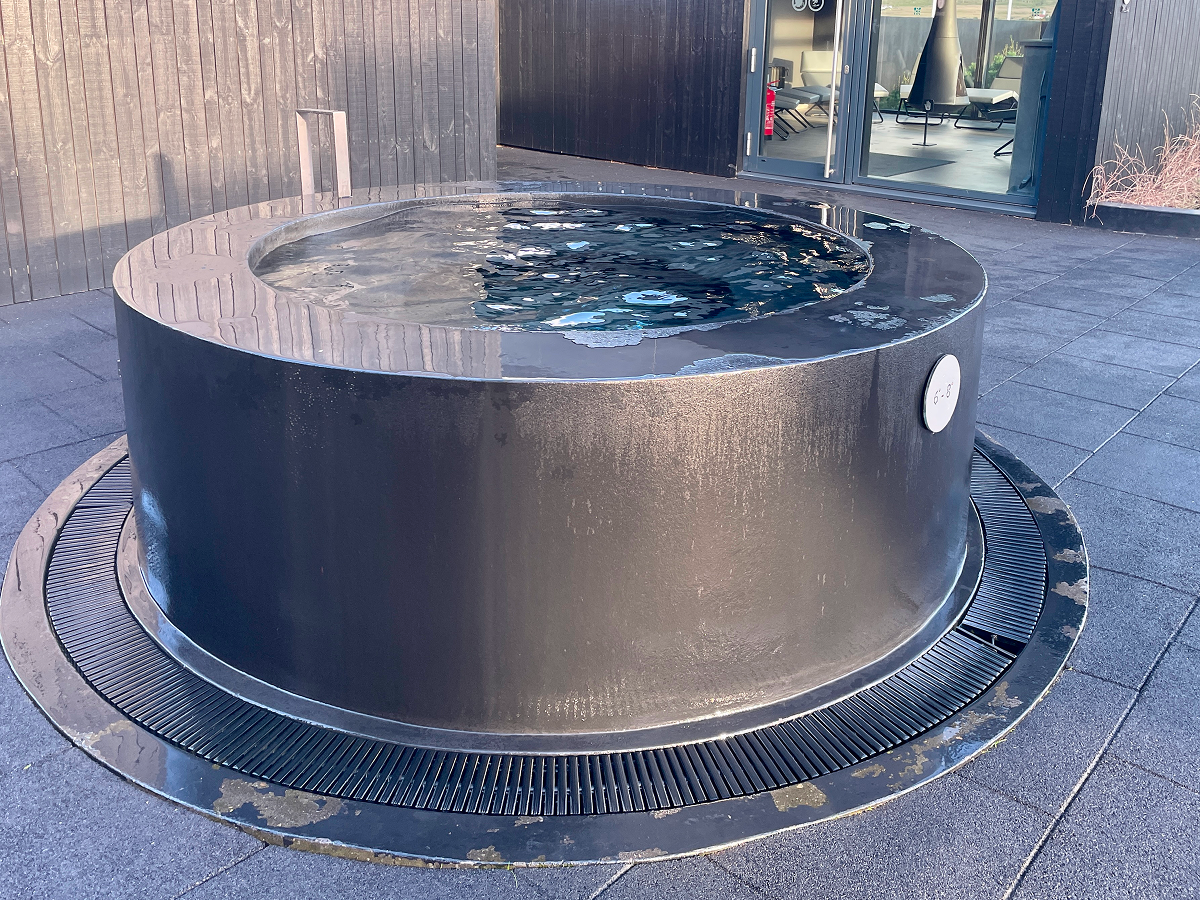
A luxury spa is a weird place to find a glacier, especially one that is dead. Spas are about relaxing and rejuvenating; dead glaciers are about environmental apocalypse. Spas are comfortable; dead glaciers are not. Maybe that is why Iceland’s Krauma Spa only mentions Okjökull’s glacier funeral online, their use of its famous waters credited on their blog, but not in person (Herrera 2020). The 2019 funeral, when organizers declared the Okjökull Glacier deceased in a high-profile ceremony, mostly vanishes within Krauma’s comfort-driven space. The spa’s calm, dark-modern aesthetics—slate-grey lobby, somber black woodwork, and stylized aerial photography that include unnamed images of Okjökull—might transform from soothing to foreboding if recast as the home of a dead glacier. The cold-water plunge tank turns from inviting to morose when reframed as meltwater remains.
Of course, this dead glacier lens is out of place at a tranquil spa; it is just melted ice water after all, not a corpse. But there is a gap between what is presented online and experienced in person, the dead glacier disappearing from physical space in ways that reveal certain contradictions: silence and consumerism where there might be awareness and conservation, but also life where death has been declared, new beginnings instead of endings.

An infrastructural approach to dead glaciers exposes the confusion, questions and contradictions that accompany an extinguished glacier in the world of the living (Larkin 2013; Howe et al. 2016). Is a glacier dead if it still provides enough meltwater for a spa? The authority to pronounce glaciers dead or capitalize on their melting ultimately depends upon power, which can play out through infrastructures that prioritize the wishes of some while ignoring, undermining or damaging the experiences of others. Inequalities are everywhere around ice (Carey and Moulton 2023), even in postglacial places. Dead glacier infrastructures, as we call them, consider the physical infrastructures around dead glaciers—hiking trails, sightseeing tours, lodges, roads and spas—in combination with the media infrastructures that promote dead glaciers, including webpages, newspapers and digital media. Viewed together, dead glacier infrastructures and the gaps between them surface hidden power dynamics and reveal what they actually accomplish, and for whom.
The quiet town of Húsafell is the perfect hiding place for a famous dead glacier wanting to avoid all the attention glaciers get these days (Quaglia 2022; Stautner 2025; Zhong et al. 2025). Online, Iceland’s first dead glacier to be given a funeral receives consistent coverage, from fresh glacier funerals in new places (Leibman 2025) to a glacier graveyard (McCaig 2024) and a global glacier casualty list (Boyer and Howe 2024). But locally in its hometown, Okjökull’s celebrity status is ignored, the trail to its final resting place and commemorative plaque mostly unvisited. Instead, Langjökull—Okjökull’s much larger, yet also dying neighbor—buzzes with activity: hiking trails to sweeping glacier vistas, glacier snowmobiling, glacier ice caving, helicopter tours from Reykjavik, an under-ice wedding chapel, and an eight-wheel monster truck adventure to the world’s largest human-made tunnel “Into the Glacier” that includes a “ride up to the glacier in a modified NATO missile launcher truck!” (Into the Glacier 2023).
These dead glacier infrastructures attract global travelers whose emissions help hasten the glacier’s death (Lam and Tegelberg 2020), even as they mention Okjökull’s demise online. Instead of stimulating sustainability, such infrastructures become tools for consumption that do not fulfill the promise of “dark tourism” to create change (Varnajot and Salim 2025). The infrastructure discloses when a glacier’s death is convenient and how it is used: at a distance.
The most recent glacier to have a funeral is not dead yet. Yala Glacier in Nepal is melting rapidly, but is not expected to disappear until the 2040s. Prematurely consigned to the grave, Yala has already been mourned in Iceland as part of the 2024 Glacier Graveyard, its name carved into an ice headstone that melted before its glacier “tribute” took place in Nepal (Leibman 2025). For the International Centre for Integrated Mountain Development and a local Tibetan Buddhist Indigenous community, this tribute was an important cultural distinction oriented towards honor, respect and wellbeing (Leibman 2025; Seldon 2025) that also raised awareness about melting Hindu Kush Himalayan glaciers. Local spiritual leaders offered the glacier blessings and the ceremony was connected to monitoring training for local scientists. This glacier’s premature death and the move from glacier funeral to tribute expose how dead glacier media infrastructures can overpower local practices and spiritual beliefs, falsely characterize glaciers as already gone, and ultimately predetermine demise and “ruined futures” (Jackson 2015).
Bolivia’s Chacaltaya Glacier is not just dead; it is gone. The ice completely melted and disappeared in 2009 (Kaenzig et al. 2016). For decades before that, Chacaltaya could boast being the highest ski resort on the planet. Now, the once-icy slopes have transformed into barren rock. The old ski lodge, chairlift towers and rusted cables strewn across the treeless mountainside look like detritus—a haunting example of dead glacier infrastructure. And yet, Adolfo Mendoza, one of the Bolivian Andean Club refuge and ski resort caretakers from the icy days, still hikes to the alpine refuge almost daily (Lana n.d.). Tourists continue to visit. He lets them into the old ski lodge turned climate museum to drink coca tea and learn about the former life of the Chacaltaya Glacier. Mendoza dreams of resuscitating the snowy terrain: “We hope to relaunch skiing ... to bring the place back to life” (Palomo et al. 2025: 116–17), but the mountain still nourishes him and the glacier lives on in memories, photographs and stories—other types of dead glacier infrastructures.
Others living and working around Chacaltaya feel like life never left, even if climate change killed the glacier. Isabel Moreno has been researching at the Chacaltaya Global Atmosphere Watch station for fifteen years and understands the history of the glacier and its disappearance. But she says Chacaltaya “makes me feel safe” (Palomo et al. 2025: 52). Moreno sees this as a place that made her career and her friendships. She enjoys seeing Adolfo Mendoza, the tourists, and other researchers studying and sleeping on the mountain. She even continued working on Chacaltaya after getting pregnant with her first child. Simplistic news coverage and attention-grabbing media that focus only on the vanished glacier and troubling images of dead glacier infrastructures like abandoned chairlifts overlook the way this mountain landscape still thrives and supports people. The death of the glacier did not in fact kill the place or the people; instead it is a place of birth, too, of “life-giving beginnings” (Palomo et al. 2025: 52).
The deadness of glaciers is often contested and contradicted. Glaciologist Allen Pope observes that determining the point when ice transitions from a glacier to a non-glacier is “ambiguous” and “messy” (Pope 2025: 3). Glacier National Park’s Siyeh Glacier in Montana was once removed from the park’s glacier inventory because it was too small, only to be resuscitated in 2015 when new satellite images revealed substantial areas of debris-covered ice that were obscured in earlier aerial photographs. In 2017, one of Argentina’s top glaciologists nearly landed in prison for using an international standard of 1 hectare for the minimum size of a glacier, whereas the environmental group that sued him on criminal charges under the country’s glacier protection law sought a smaller size for the legal limit of a dead glacier (Tollefson and Rodríguez Mega 2017). Thus, a man’s freedom hinged on the legal and political jockeying over whether a glacier was there, or gone.
Unnamed glaciers disappear but do not get to die because they do not have names. Slovenia lost its glaciers years ago (Camacho 2024), just without the hype. Chacaltaya died too soon for a funeral, before glaciers became celebrities via global media infrastructures.
The dead glacier concept appears useful on the surface, but its contradictions and manifestations show how dead glacie r infrastructures actually serve the masters of infrastructures, not the glaciers themselves or local communities. Dead glaciers appear online, but not in person; they promote tourism and consumerism, but mention of them disappears once the glaciers are gone; they stress ice loss, but overlook people’s ongoing lives nearby. As a priest in a documentary on Okjökull Glacier admonished: “It is very important to remember that funerals and rituals of grief are not for the dead ones, specifically, they are for the living” (Boyer and Howe 2018: 29:43). Through infrastructures, the cult of personality behind dead glaciers can be mobilized for profit and power, and misrepresent, oversimplify or ignore reality, with unintended consequences for people. The Global Glacier Casualty List, another dead glacier infrastructure, mistakes glacier death as the cause of Tlingít displacement from Glacier Bay National Park, when in fact—quite the opposite—a surging glacier and the US federal government bear responsibility. Here, dead glacier infrastructure conflates diverse Alaska Natives from across the state and the different challenges they face. It glosses over Indigenous and climate histories and simplifies complex tidewater glacier dynamics, all in service of describing “the massive Alaskan glacial decline to come” (Pelto 2024).
Still, dead glaciers tap into important emotions and have power. The priest’s reminder applies not just to funerals, but to all dead glacier infrastructures: they are for, and should serve, the living. Given the contested nature of glacial death, clarifying these power dynamics is vital for promoting awareness, directing action to mitigate ice loss, and empowering local communities, people and glaciers.
Boyer, Dominic and Cymene Howe. 2024. “Global Glacier Casualty List.” Global Glacier Casualty list, 17 August. https://doi.org/10.25613/CZJA-9V56
Boyer, Dominic and Cymene Howe. 2018. “Not Ok (A Little Movie About a Small Glacier at the End of the World).” Documentary film. https://notokmovie.com
Camacho, Francisco. 2024. “Slovenia was the first country to lose its last glacier. Then came Venezuela.” E&E News, 20 May. https://www.eenews.net/articles/slovenia-was-the-first-country-to-lose-its-last-glacier-then-came-venezuela
Carey, Mark and Holly Moulton. 2023. "Inequalities of Ice Loss: A Framework for Addressing Socio-Cryospheric Change." Annals of Glaciology 64 (91): 67–76.
Herrera, Raquel. 2020. “All you need to know about Ok Glacier, the first dead glacier in Iceland.” Krauma Spa, 24 July. https://www.krauma.is/all-you-need-to-know-about-ok-glacier-the-first-dead-glacier-in-iceland
Howe, Cymene, Jessica Lockrem, Hannah Appel, Edward Hackett, Dominic Boyer, Randal Hall, Matthew Schneider-Mayerson, Albert Pope, Akhil Gupta, Elizabeth Rodwell, Andrea Ballestero, Trevor Durbin, Farès el-Dahdah, Elizabeth Long and Cyrus Mody. 2016. “Paradoxical Infrastructures: Ruins, Retrofit, and Risk.” Science, Technology, & Human Values 41 (3): 547–65.
Into the Glacier. 2023. “Langjokull Glacier: The Ultimate Guide.” https://intotheglacier.is/blog/langjokull-glacier
Jackson, M. 2015. “Glaciers and Climate Change: Narratives of Ruined Futures.” WIREs Climate Change 6 (5): 479–92.
Kaenzig, Raoul, Martine Rebetez and Gaëlle Serquet. 2016. "Climate Change Adaptation of the Tourism Sector in the Bolivian Andes." Tourism Geographies 18 (2): 111–28.
Lam, Anita and Matthew Tegelberg. 2020. “Dark Tourism in Iceberg Alley: The hidden ecological costs of consuming iceberg deaths.” In Criminal Anthroposcenes: Media and Crime in the Vanishing Arctic, edited by Anita Lam and Matthew Tegelberg, 145–87. Palgrave Macmillan.
Lana, Sofia. N.d. “‘La vida sigue’ (life continues) after glacial melt on Mt. Chacaltaya, Bolivia,” unpublished manuscript.
Larkin, Brian. 2013. “The Politics and Poetics of Infrastructure.” Annual Review of Anthropology 42 (1): 327–43.
Leibman, Kerianne. 2025. “In Nepal, scientists and spiritual leaders honor a dying glacier.” Columbia Climate School State of the Planet, 18 September. https://news.climate.columbia.edu/2025/09/18/in-nepal-scientists-and-spiritual-leaders-honor-a-dying-glacier
McCaig, Amy. 2024. “Glaciers in peril: World’s first glacier graveyard and global glacier casualty list unveiled.” Rice News, 18 August. https://news.rice.edu/news/2024/glaciers-peril-worlds-first-glacier-graveyard-and-global-glacier-casualty-list-unveiled
Palomo, Ignacio, Sofía Lana, Antoine Rabatel and Oliver Dangles. 2025. The Voices of Glaciers: Stories of Grief and Hope Amidst Shrinking Glaciers in the Tropics. IRD Éditions-UNESCO.
Pelto, Mauri. 2024. “Burroughs glacier.” Global Glacier Casualty List https://glaciercasualtylist.rice.edu/?data_id=dataSource_1-18ec41ee5e2-layer-75%3A43&dlg=ARTICLE&page=Page, curated by Dominic Boyer and Cymene Howe.
Pope, Allen. 2025. “Glacier or Not? The Importance of Nuance in Definitions of Vanishing Glaciers.” Annals of Glaciology 66 (32): 1-8. https://doi.org/10.1017/aog.2025.10030
Quaglia, Sofia. 2022. “Glacier grief: how funerals and rituals can help us mourn the loss of nature.” The Guardian, 10 October. https://www.theguardian.com/environment/2022/oct/10/glacier-grief-how-funerals-and-rituals-can-help-us-mourn-the-loss-of-nature-aoe
Seldon, Chimi. 2025. “In deep reverence to Yala Glacier.” ICIMOD, 18 December. https://blog.icimod.org/cryosphere-water-risks/in-deep-reverence-to-yala-glacier
Stautner, Lutz. 2025. “The last words of a dying glacier.” The New York Times, 8 July. https://www.nytimes.com/2025/07/08/opinion/climate-change-melting-glacier.html
Tollefson, Jeff and Emiliano Rodríguez Mega. 2017. “Geoscientist Faces Criminal Charges over Glacier Survey.” Nature 552: 159–60.
Varnajot, Alix and Emmanuel Salim. 2025. “The Hauntology of Climate Change: Glacier Retreat and Dark Tourism.” Tourism Geographies 27 (1): 102–19. https://doi.org/10.1080/14616688.2024.2328607
Zhong, Raymond, Jason Gulley and Bora Erden. 2025. “A Dead Glacier Is a Loss. A Dying One Is a Threat.” The New York Times, 14 November. https://www.nytimes.com/interactive/2025/11/14/climate/glacier-melt-himalayas.html