This is some text inside of a div block.
Search across the whole Roadsides site


The history of the Alps is not merely a geological timeline of rock and ice; it is equally a history of human perception. For centuries, the Alpine summits were viewed with apprehension—an inconvenient, formidable barrier that travellers were compelled to cross out of necessity rather than desire. Until the seventeenth century, the high mountains were a terra incognita of danger and sterility. Yet European history reveals a profound paradigm shift beginning in the late seventeenth and eighteenth centuries, transforming these high-altitude wastelands into landscapes of the ‘sublime’ (Zuelow 2016). This shift is most visible in the rich corpus of glacier images that have survived to the present day. These images serve a dual, perhaps contradictory, function for the modern scholar: they are invaluable data for historical glaciology, enabling the reconstruction of past climate variability up to today’s warming world, and they are also potent cultural artefacts illuminating the social history of tourism.
By analysing the evolution of humans travelling for pleasure within these glacial frames—from Grand Tour travellers and Enlightenment scientists to the Belle Époque bourgeois tourists—I uncover a surprising prehistory to our contemporary culture of self-representation. We must ask: Did the performative social media trend of today, which I would like to label as Instagram society, actually start around 1900? And what made and makes glaciers Instagrammable? This second question concerning the fascination of the cryosphere for tourists is not only relevant to today’s visual culture of social media but can also be traced back to the Belle Époque, when bourgeois tourists in the Alps and in other mountainous regions posed on or in front of glaciers for photographs.
Until the early modern period, crossing the Alps was a perilous necessity, devoid of aesthetic appreciation. Only in the late seventeenth and eighteenth centuries was the horror of the mountains transformed into fascination. This development is closely linked to the emergence of the Grand Tour, an educational journey to Italy undertaken primarily by the British aristocracy, which was regarded as a rite of passage for young men. On their journey, they often crossed the Alpine passes in Haute-Savoie and south-western Switzerland. Their accounts testify to a significant change in the perception of the Alps. This era witnessed the ascent of medium-altitude viewpoints, such as the Rigi mountain (1,797m), and the creation of the first significant corpus of Alpine paintings.
While isolated examples exist from the seventeenth century, dense production of imagery began around 1770 (Zumbühl 1980; Nussbaumer et al. 2012; Reichler 2013; Zumbühl et al. 2016).[1] Artists focused on accessible wonders, most notably the glaciers of Grindelwald in the Bernese Alps. These early images were not merely decorative; they were attempts to capture the sublime—that romantic mixture of awe and terror induced by the sheer scale of nature. It is important to remember that this artistic fascination coincided with the latter stages of the Little Ice Age; the glaciers depicted were far larger and more menacing than those we see today, extending deep into the valleys and interacting directly with human settlements.
For the environmental historian and the glaciologist, these pictorial sources are more than art; they are evidence. Under the methodological framework developed by Heinz J. Zumbühl since the 1980s, serial iconography allows researchers to reconstruct glacier fluctuations long before the advent of satellite telemetry or even photography (Zumbühl 1980; Zumbühl et al. 2016; Zumbühl and Nussbaumer 2018). However, the evaluation of these sources requires rigorous critique and epistemological caution.
The scholar must navigate a diverse array of image types, from Romantic oil paintings to technical topographic drawings. The challenge lies in the truth claim of the image. For glaciology to benefit scientifically, a sufficient density of images of a specific glacier is required over a long period. This enables the cross-referencing of distinctive landmarks—rock formations or unique valley features that remain constant while the ice shifts. Furthermore, precise dating is imperative: knowing the year, and ideally the season, is necessary to track the glacier’s mass balance. This work transforms the painter’s canvas into a climatological record, allowing us to quantify the retreat of the ice over centuries.
The most telling evolution within these images, though, is not the ice, but the human figures standing upon it. The representation of humans in glacier imagery reflects the sociological development of Alpinism from scientific inquiry to sporting conquest and bourgeois mass tourism.
In the late eighteenth century, the dominant figure was the Enlightenment scientist. Horace Bénédict de Saussure (1740–1799), a polymath from Geneva, epitomised this era. His seminal work, Voyages dans les Alpes (1779–1796), and his personal ascent of Mont Blanc in 1787—following the prize he set for its first conquest in 1760—framed the mountains as a laboratory (Sigrist 2001). The imagery of this period depicts figures engaged in observation, measurement and the categorisation of nature.
By the mid-nineteenth century, the narrative had shifted to the Golden Age of Alpinism (1850s–1880s). The scientist was replaced by the sportsman, specifically the British elite (Grupp 2008). The founding of the Alpine Club in London (1857) marked the mountains as a “playground” for the wealthy (Stephen 1871). This era culminated in Edward Whymper’s competitive ascent of the Matterhorn in 1865, viewing the summit not as a place for barometer readings but as a trophy of physical endurance.
The late nineteenth century brought a ‘democratisation’ of the peaks that fundamentally altered the visual landscape. The foundation of the Austrian (1862) and Swiss (1863) Alpine Clubs, combined with the logistical revolution of Thomas Cook’s organised group travels, opened the Alps to the upper middle class. Crucially, the proliferation of mass travel guidebooks, such as those by Murray and Baedeker, scripted the Alpine experience. These guidebooks told tourists where to go, what to see, and importantly, where to stand to get the ‘canonical’ view (Müller 2012; Zuelow 2016; Rohr 2023).
As Alpinism transitioned from an elite eccentricity to a mass phenomenon, the glacier became a stage for social distinction. This is evident in the explosion of posed photography from 1870 onwards. Due to the long exposure times required by early photography, these scenes were necessarily orchestrated. The candid chaos of exploration was replaced by the frozen tableau of the tourist.
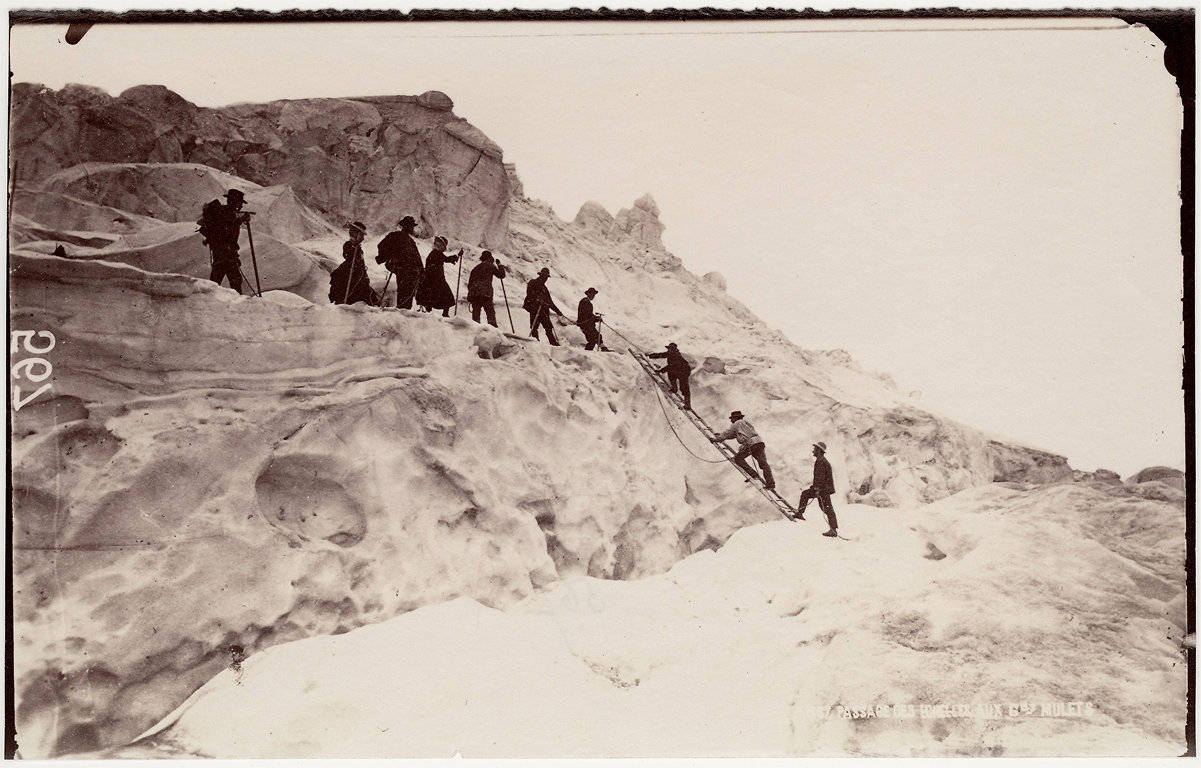
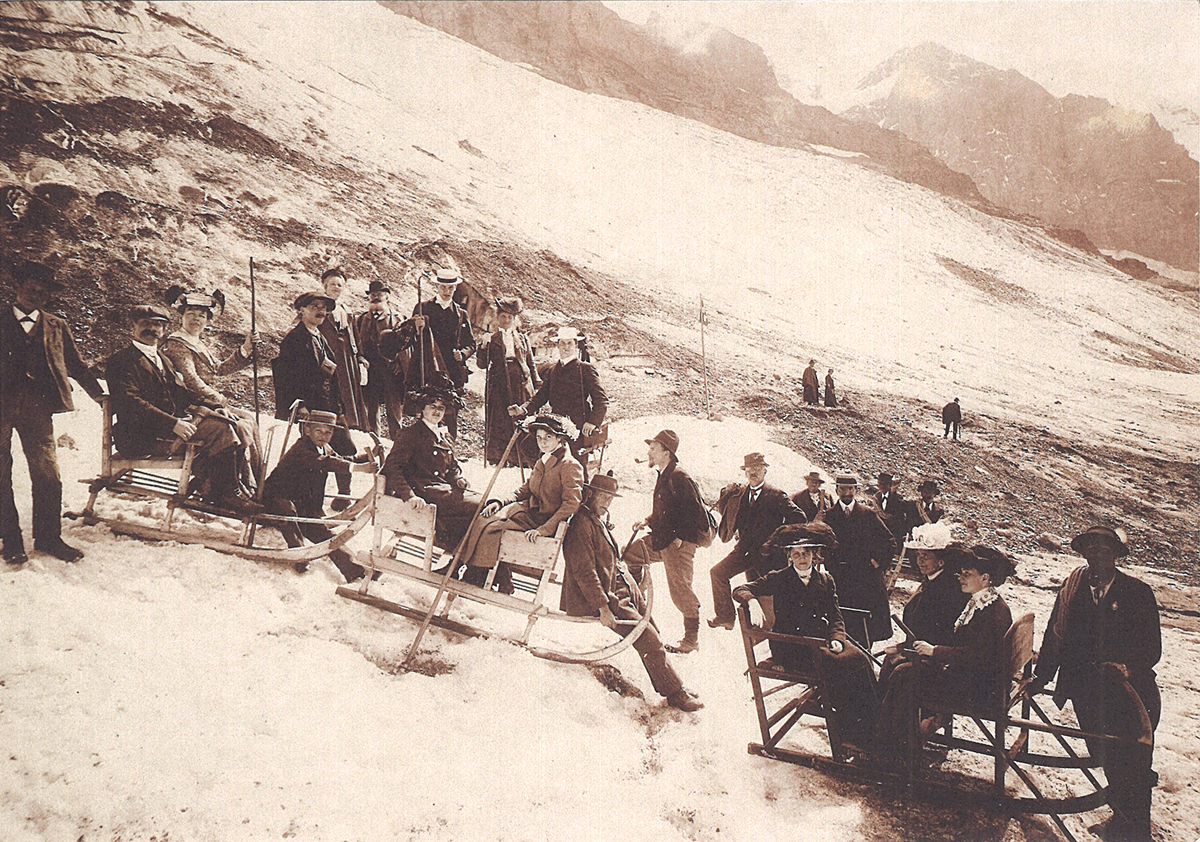
It is during the Belle Époque that the visual culture of the Alps begins to mirror our contemporary social media practices. Recent studies on social media have highlighted the prominent role of photography of travel and other occasions in self-presentation and network-building (Lambert 2013; Simanowski 2018; Leaver, Highfield and Abidin 2020). The concept of the Instagram society introduced here for historical societies suggests that the value of travel lies in its documentation and dissemination as a means of identity construction.[2] I argue that this dynamic was already fully present around 1900.
Consider the images of bourgeois tourists crossing the Glacier de Bossons or posing on the Eiger glacier with sledges. These were not snapshots of exploration; they were carefully curated acts of self-representation, providing a clear distinction from anonymous mass-produced postcards. The presence of tourists in urban attire on the ice, often framed by unseen guides and photographers, served a clear social function. Just as the Grand Hôtel offered a venue for display, the glacier offered a backdrop for projecting an image of adventurous modernity. The infrastructure of the era catered to this desire. The construction of cog railways, such as the line to the Jungfraujoch, was specifically intended to provide desirable glacier views for those unwilling to climb (König 2000; Rohr 2023).
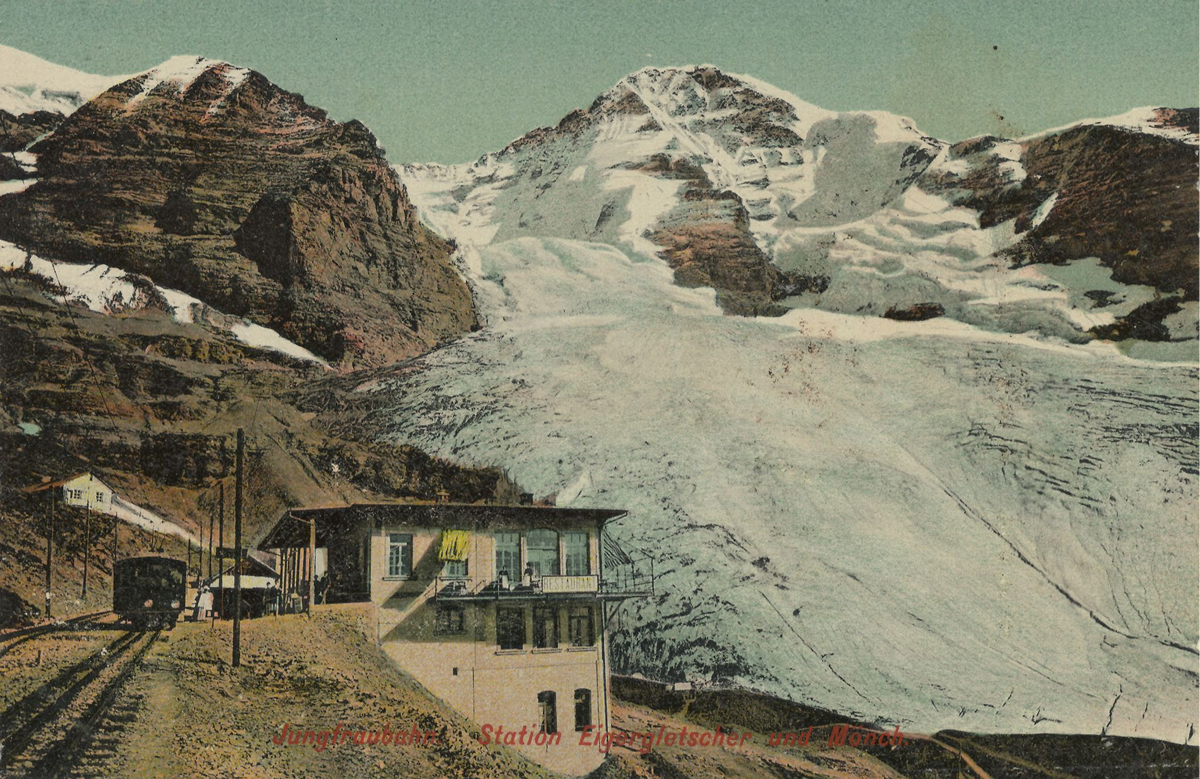
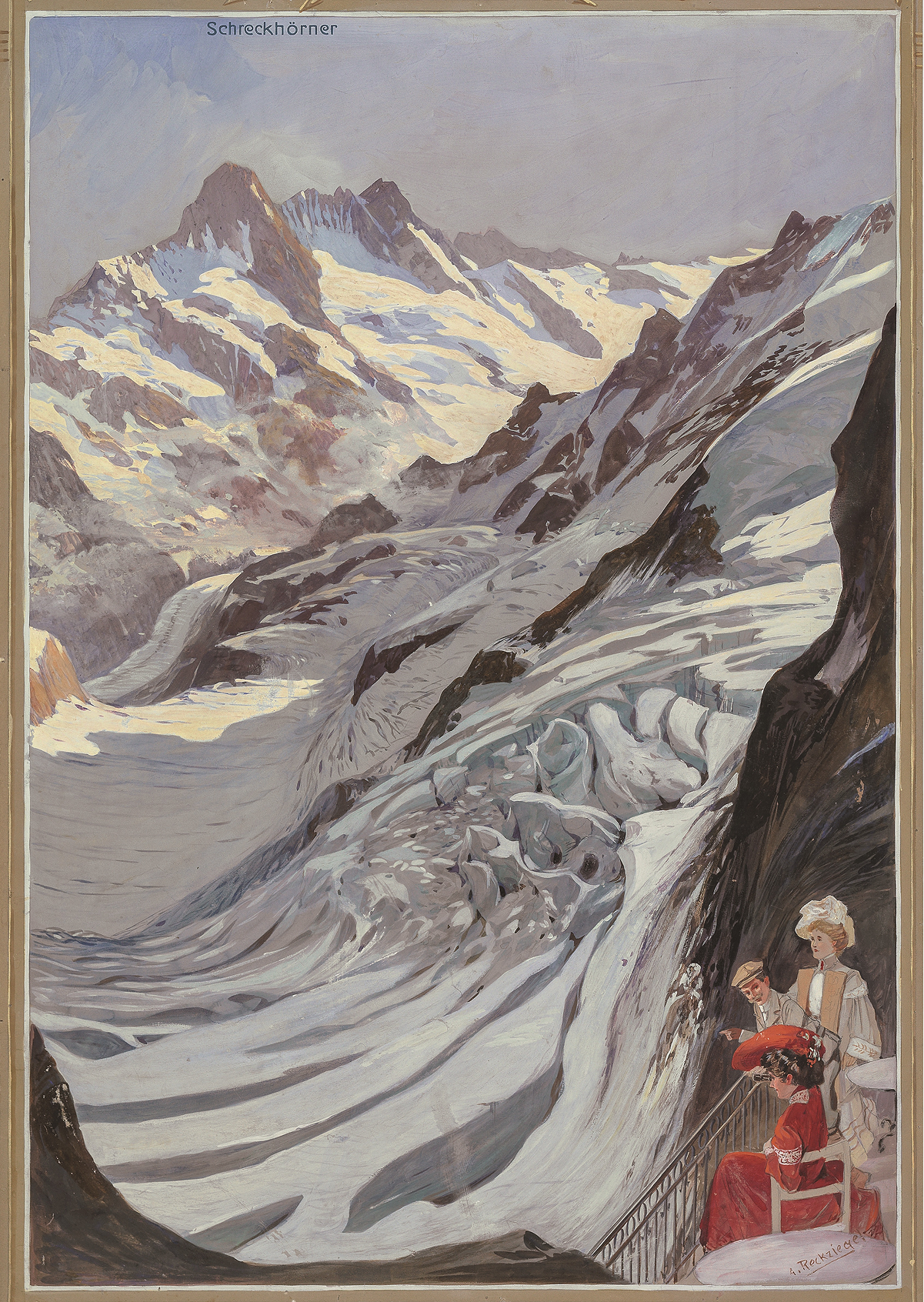
Advertising posters of the era, such as Anton Reckziegel’s 1905 drafts, promised the bourgeois traveller a seamless integration of comfort and wilderness.[3] The resulting photographs—showing tourists posing at the Eismeer station or on the Grindelwald glacier—conceal the ease of access while emphasising the dramatic setting. This creates an illusion that is idealised to today: the illusion of being alone in the wild, captured for an audience back home. The staff—the guides and photographers—are erased from the frame, much like the logistical support behind a modern influencer’s post.
When we view a photograph of Asian tourists posing on the Jungfraujoch in July 2024, distinct against the snow, we witness the continuation of a lineage that began over a century ago. The technology has shifted from heavy plate cameras to smartphones, but the sociological impulse remains the same. The turn of the twentieth century saw the birth of travel as a means of visual social distinction. The bourgeois tourists of the Belle Époque used the glacier as a prop for identity construction, relying on a hidden infrastructure of railways and guides to curate an image of adventurous leisure.
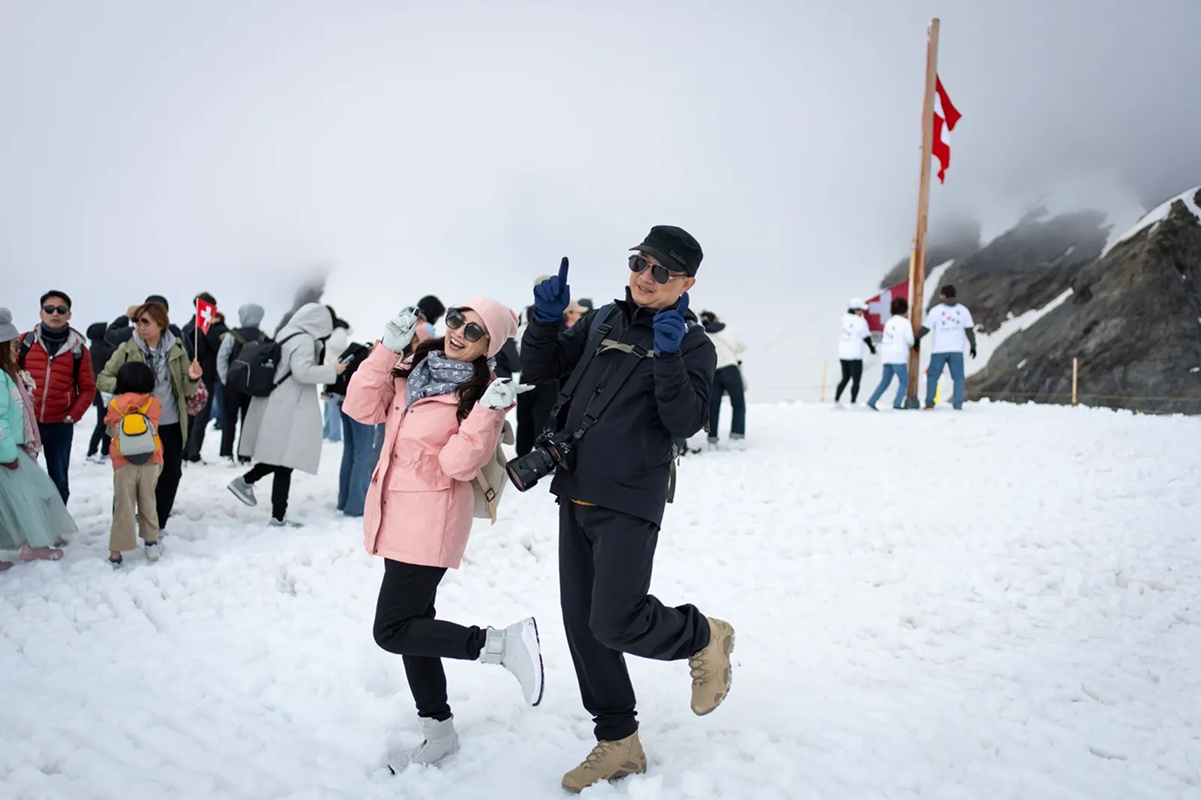
However, a sombre realisation underpins this historical continuity. The glaciers that served as the backdrop for De Saussure’s science, the British elite’s sport and the bourgeois selfies of 1900 are vanishing. The easy accessibility provided by the cog railways remains, but the visual commodity—the ice itself—is retreating. As we move further into the twenty-first century, with the rising popularity of ‘last chance’ glacier tourism in the Alps and elsewhere,[4] we must wonder: Can Alpine tourism survive the loss of its primary visual asset? The historical images endure as a testament to what was lost, freezing in time both the sprawling ice of the Little Ice Age and the burgeoning vanity of the modern tourist.
Barton, Belinda and Edmund Goh. 2025. “Last chance tourism: A systematic literature review and future research directions.” Tourism Management Perspectives 57: 101361. https://www.sciencedirect.com/science/article/pii/S221197362500025X
De Saussure, Horace Bénédict. 1779–1796. Voyages dans les Alpes, précédés d'un essai sur l'histoire naturelle des environs de Genève. Samuel Fauche.
Grupp, Peter. 2008. Faszination Berg. Die Geschichte des Alpinismus. Böhlau.
Hoffmann, Felix and Kathrin Schönegg (eds.). 2021. Send me an Image: From Postcards to Social Media. Steidl.
Kneubühl, Urs and Agathon Aerni. 2016. Reklamekunst und Reiseträume. Anton Reckziegel und die Frühzeit des Tourismusplakates. Scheidegger & Spiess.
König, Wolfgang. 2000. Bahnen und Berge. Verkehrstechnik, Tourismus und Naturschutz in den Schweizer Alpen 1870–1939. Campus.
Lambert, Alexander. 2013. Intimacy and Friendship on Facebook. Palgrave Macmillan.
Leaver, Tama, Tim Highfield and Crystal Abidin. 2020. Instagram: Visual Social Media Cultures. Polity.
Müller, Suzanne. 2012. Die Welt des Baedeker. Eine Medienkulturgeschichte des Reiseführers 1830–1945. Campus.
Nussbaumer, Samuel U., Philip Deline, Christian Vincent and Heinz J. Zumbühl (eds). 2012. Mer de Glace. Art & Science. Atelier Esope.
Reichler, Claude. 2013. Les Alpes et leurs imagiers. Voyage et histoire du regard. EPFL Press.
Rohr, Christian. 2023. “Bergbahnen als Symbole und Promotoren des Alpentourismus. Das Berner Oberland in der Belle Époque – mit einem Vergleich zum Salzkammergut.” Geschichte und Region / Storia e regione 32 (1): 121–46.
Salim, Emmanuel and Ludovic Ravanel. 2023. “Last chance to see the ice: Visitor motivation at Montenvers-Mer-de-glace, French Alps.” Tourism Geographies. An International Journal of Tourism Space, Place and Environment 25 (1): 72–94.
Salim, Emmanuel, Marius Mayer, Philipp Sacher and Ludovic Ravanel. 2023. “Visitors’ motivations to engage in glacier tourism in the European Alps: Comparison of six sites in France, Switzerland, and Austria.” Journal of Sustainable Tourism 31 (6): 1373–93.
Sigrist, René (ed.). 2001. H.-B. de Saussure (1740–1799). Un regard sur la terre. Georg.
Simanowski, Roberto. 2018. Facebook society. Losing Ourselves in Sharing Ourselves. Columbia University Press.
Stephen, Leslie. 1871. The Playground of Europe. Longmans, Green.
Zuelow, Eric G. E. 2016. A History of Modern Tourism. Palgrave Macmillan.
Zumbühl, Heinz J. 1980. Die Schwankungen der Grindelwaldgletscher in den historischen Bild- und Schriftquellen des 12. bis 19. Jahrhunderts. Ein Beitrag zur Gletschergeschichte und Erforschung des Alpenraumes. Birkhäuser.
Zumbühl, Heinz J. and Samuel U. Nussbaumer. 2018. “Little Ice Age Glacier History of the Central and Western Alps from Pictorial Documents.” Cuadernos de Investigación Geográfica 44: 115–36.
Zumbühl, Heinz J., Samuel U. Nussbaumer, Hanspeter Holzhauser and Richard Wolf (eds.). 2016. Die Grindelwaldgletscher. Kunst und Wissenschaft. Haupt.