This is some text inside of a div block.
Search across the whole Roadsides site


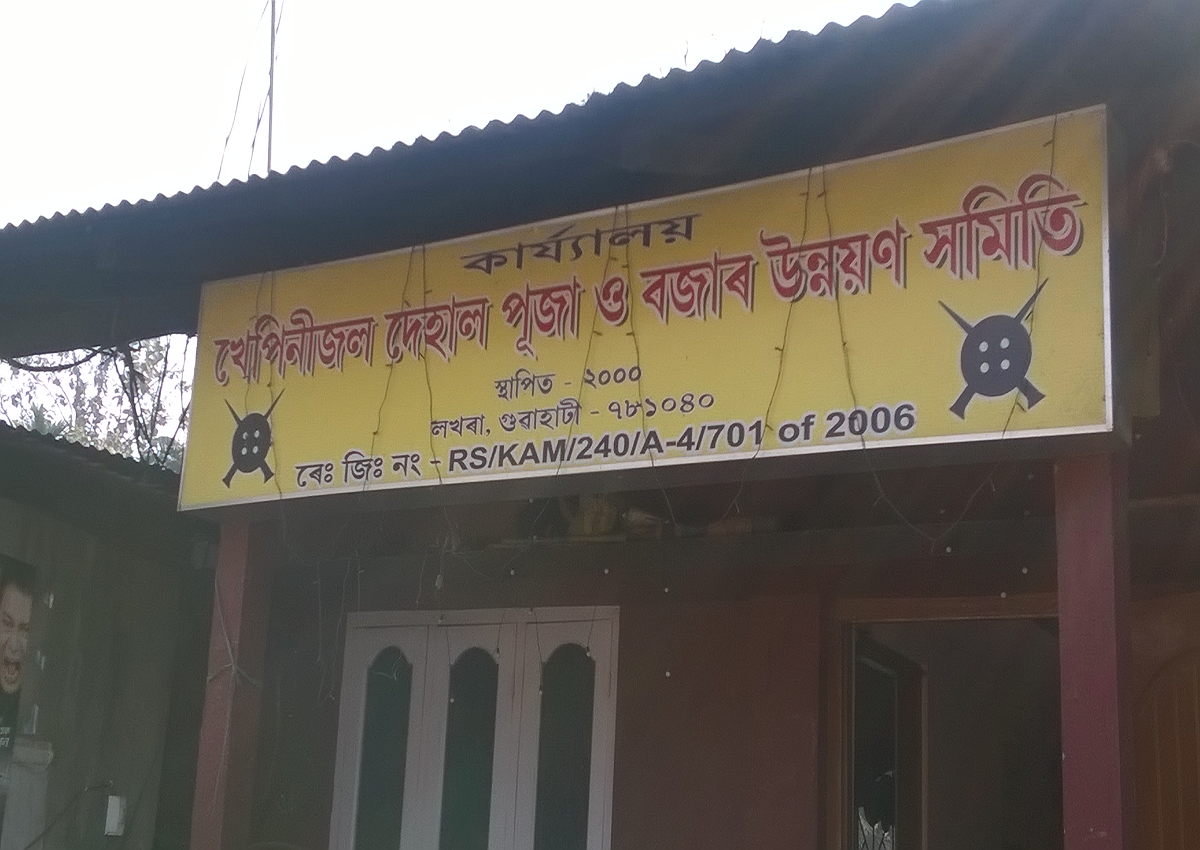
On a Sunday afternoon in June 2019, I entered the busy weekly market of Khepinijal Karbi Bazaar held in Guwahati, a metropolitan city in Assam, northeast India. I saw a group of women vendors sipping cups of tea and eating local rice cakes pitha (পিঠা) while bargaining with customers. I sat with them to have a conversation in Assamese, one of Assam’s commonly spoken languages. Our conversations that began about the market and its problems gradually shifted to how vendors bonded to each other. They reflected on how the market gave them a space to listen to people’s stories of success and struggle. In this context, the essay focuses on women as individuals with agency whose occupational work in male-oriented economic spaces challenges dominant economic interpretations of markets (Gago 2017: 14). Unlike mainstream economic theories that stress quantitative measures such as individual interest, profits and wages, the focus of this essay is on social relations such as care, solidarity, trust and a feeling of community. Paying attention to these relations helps us to understand the structure and functioning of markets as spaces of gendered becoming and community formation for women vendors (Graham-Gibson 2014: S149).
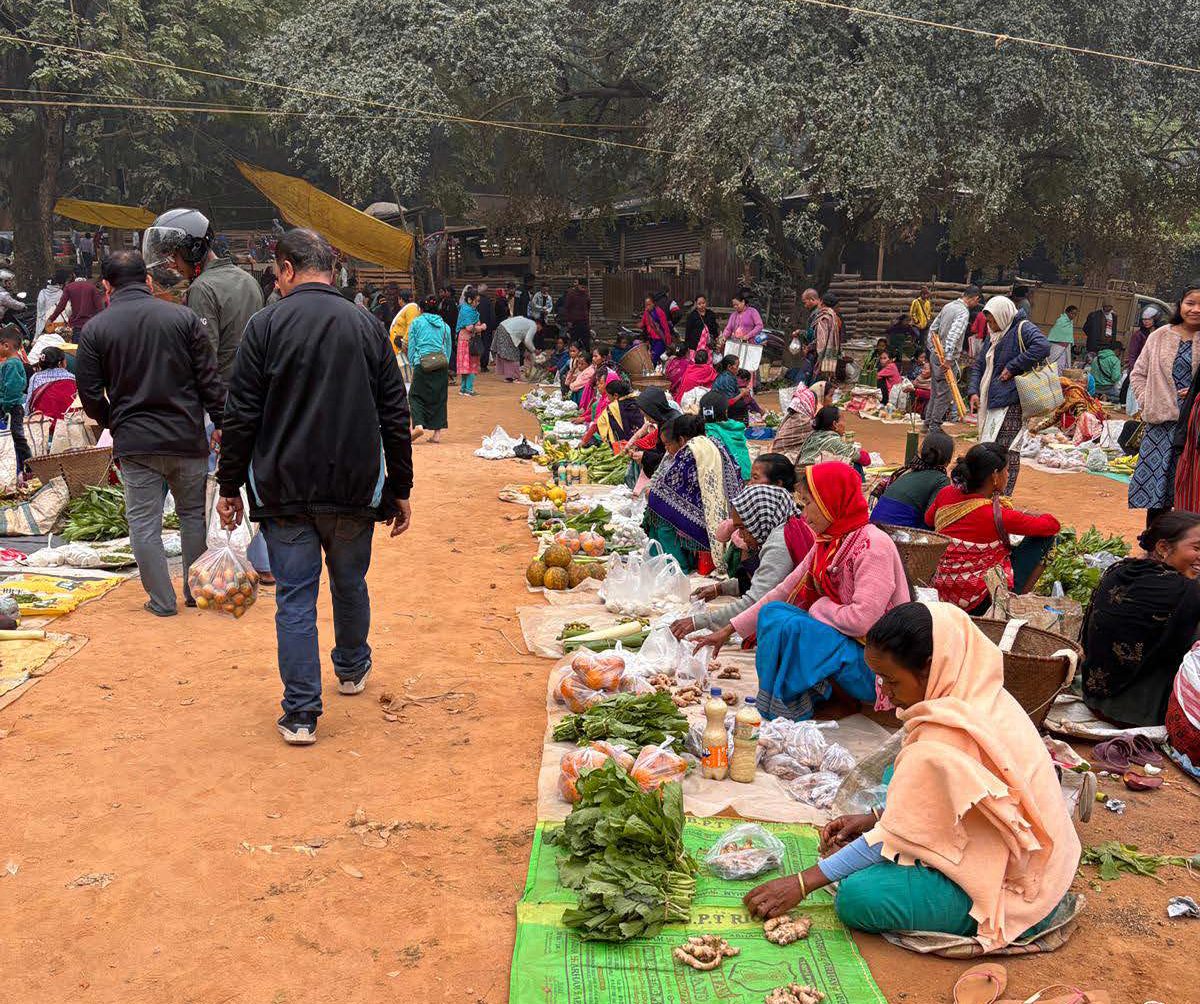
The market, which takes place every Sunday, is managed by the Karbi ethnic community that resides in the Lokhora area of Guwahati. The Karbi are one of numerous Indigenous communities of Assam, residing both in the hills and on the plains, particularly in Guwahati and Nagaon. Although the market is registered, the vendors are informal. Hence there are no official records of who they are. The majority of vendors, both men and women, come from tribal ethnic communities like Karbi, Bodo or Mising, from villages around 15–30 kilometers away. They arrive early in the morning and stay late until their commodities, especially all perishable items, are sold. Some vendors also come from Meghalaya, a neighboring state to sell agricultural and forest produce. Furthermore, Muslim male vendors who migrated from riverine areas of Assam are also seen selling household commodities, fish and clothes.
The arrangement of the market is highly gendered. The authorities are all men: from the president to volunteers, the market association comprises only male members. Infrastructural concern towards women remains invisible.
Women are active participants at several weekly markets held in Assam. However, their presence does not seem to lead to any improvements to the market infrastructure (Sugawara 2023). Temporary shades, plastic mats for sitting on and a lack of proper toilet facilities make these women vendors vulnerable. Many vendors simply sit under an umbrella, while most women restrict their fluid intake to avoid toilets. For younger menstruating women, this situation leads them to avoid the market and instead sell their commodities at a lower price in nearby villages. This feminine invisibility and lack of suitable infrastructure goes hand in hand with the fact that markets are seen through a male lens. Nevertheless, as a socioeconomic space the market also reflects mutual support and community-building for women. Each woman vendor brings with them not merely commodities but also their sorrows, solidarities and strategies.
The weekly market in Guwahati is an informal space without any proper allotted individual places for vendors. Hence, each vendor must get there as early as possible to claim their spot. Women vendors who have been coming to the bazaar for several years will have secured usual spaces in the market, while new entrants build up their networks with the help of senior vendors. Some vendors also get to know each other in the market and tend to sit together while selling their commodities.
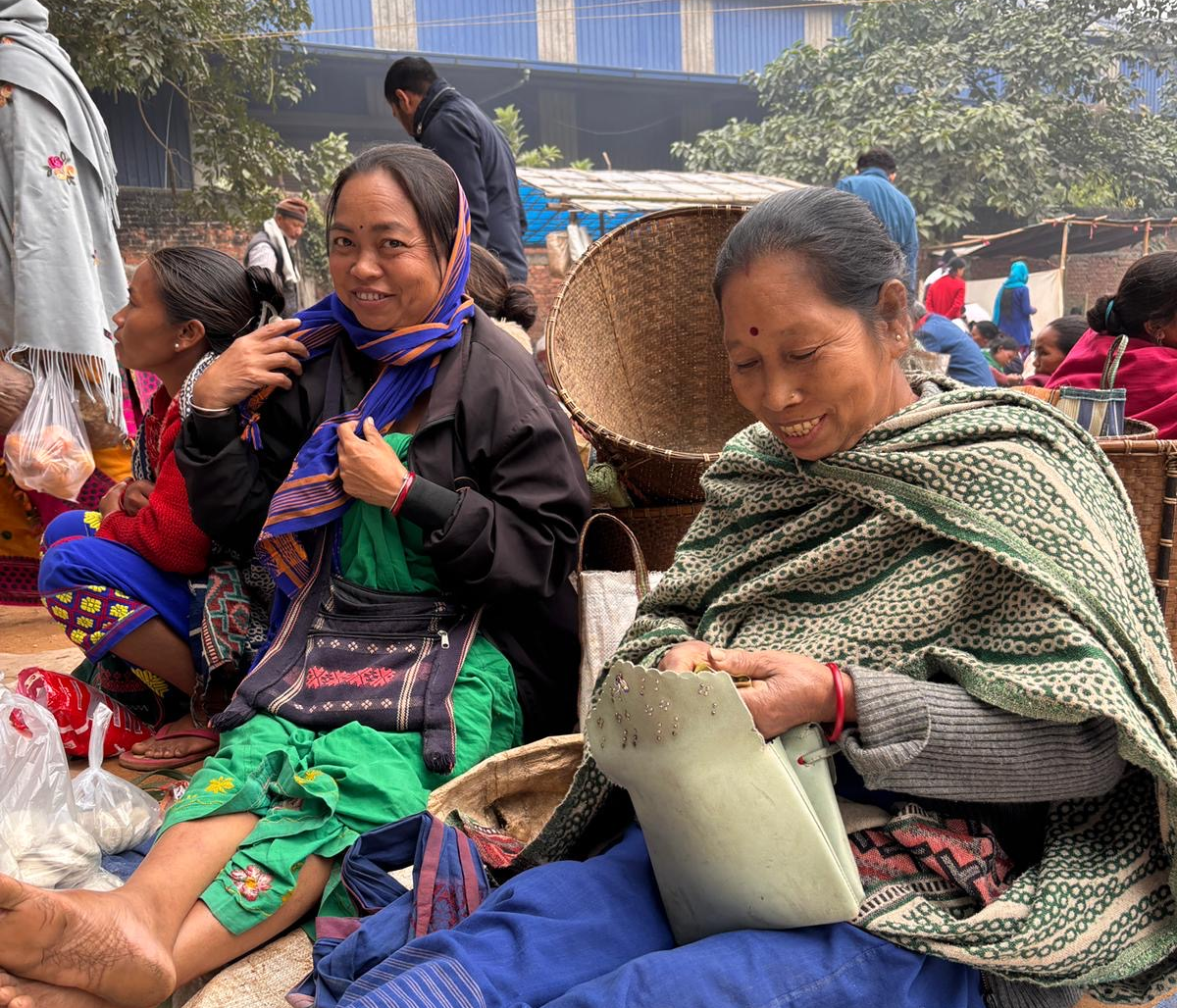
Older women serve as informal mentors for younger vendors, forming a community of mutual support. The knowledge and practical insights gained through their years of experience become a valuable guide for newcomers as they navigate the marketplace. From learning the best ways of communication to selling their commodities, vendors learn through each other’s perspectives on the market. Moina baideu (বাইদেউ, ‘elder sister’) notes, “I used to come with Nijora baideu [pointing towards another woman from the same village]. In the beginning, I sometimes helped her sell commodities. Six months later, I started selling my own vegetables after learning the business from her. We sit together and share our joys and sorrows, family problems, etc.” (Interview 2025)[1]
These two women travel to the market together from Boko (a town near Guwahati) early in the morning, at around 5 am. If one of them cannot make it for some reason, the other sells the commodities on her behalf. Similarly, if any one vendor has to go and freshen up or take a stroll around the market, the other will take care of her produce and customers. This support and solidarity between vendors reflects how a market functions in ways that go beyond economic value.
Drawing from the growing body of friendship studies (Eve 2002; Allan 2011), I contend that relationships among these vendors are not limited to mutual care and trust but are also a way to navigate shared politics and discrimination. One such example is the usage of mobile phones. Most of the women vendors group together to share a single device. The vendor who has access to a mobile phone takes responsibility for providing the group with information about any kind of emergency, time of arrival, buyers and sellers etc. (Borborah and Das 2022: 526) Thus, women’s relationships with each other help them navigate solutions to their everyday struggles. They also refer customers to one another’s commodities, encouraging buyers to purchase goods from their fellow vendors. While haggling with individual vendors is a norm in the market, I often had to simultaneously bargain with two different women who were supporting one another.
In such ways, this public marketplace becomes an intimate space of affection and mutual recognition for these vendors. Their stories reflect Nancy Fraser’s (1990: 67) concept of “subaltern counter-publics.” Fraser reconceptualizes the public sphere by highlighting how “actually existing democracies” systematically exclude many people from supposedly open deliberation (1990: 57). In response, subordinated groups create their own communicative spaces that contest dominant norms rather than simply mirroring them. While the market is not considered a formal political space, it remains deeply political as it provides a locus of visibility and recognition for women beyond the patriarchal household. Through everyday practices like coming to the market together, choosing their spots near other vendors whom they trust, arranging their commodities and bargaining with customers, these women claim their spaces in a market not designed for their empowerment (Walter and Grieser 2020).
They go to the market to socialize with other women, to sell their commodities and to retain financial independence. These earnings help in giving them a sense of control over their own lives. Moreover, despite being from different ethnic groups, these women also get closer to each other after sharing their similar narratives of widowhood, motherhood and home. They say: “We are from the same household, we are from the same family” (আমি একেখন ঘৰৰ মানুহ, আমি একেটা পৰিয়ালৰ). The vernacular expressions that vendors use to describe their bonds are usually reserved for those belonging to the same kin group. Its usage in the context of the market reflects the extension of kinship to a broader social relationship where solidarity among women from different ethnic communities is affirmed. Furthermore, using the language of kinship is a way of asserting solidarities grounded in common vulnerabilities, struggles and anxieties.
This essay adds to the growing body of gender and infrastructure scholarship that highlights how women carve out a place for themselves (Datta 2020; Walter and Grieser 2020), finding transient spaces and temporary alliances (Subramanian 2024). I see the space of the market as transient and temporally bound in the larger context of vulnerability that informal vendors face in India. Minimal infrastructure, like the plastic sheets where vendors sit without any shelter to safeguard them from scorching summer sun or winter weather, affects how they are able to participate in the market. These marketplaces are flooded with water and mud every monsoon, so vendors move from one market to another in search of better facilities and more income. Yet this precarity does not isolate them. The informal sharing of mobile phones for communication and an expectation of sitting together reflect how, in spite of infrastructural challenges, women navigate their work and build a community. These networks constructed through borrowed devices and shared information become spaces where vendors’ experiences are heard and validated, especially when the physical infrastructure around them remains unreliable.
Allan, Graham. 2011. “Commentary: Friendships and Emotions.” Sociological Research Online 16 (1): 95–99.
Borborah, Pratisha and Krishna Das. 2022. “Building Agency: Women Vendors and Gendered Technology in Informal Markets in Assam.” Gender and Development 30 (3): 517–30.
Datta, Anindita. 2020. “Reinterpreting resistance and agency: Excavating feminist counterspaces within indigenous feminisms.” In Gender, Space and Agency in India, edited by Anindita Datta, 145–59. Routledge.
Eve, Michael. 2002. “Is Friendship a Sociological Topic?” European Journal of Sociology 43: 386–409.
Fraser, Nancy. 1990. “Rethinking the Public Sphere: A Contribution to the Critique of Actually Existing Democracy.” Social Text 25/26: 56–80.
Gago, Veronica. 2017. Neoliberalism from Below: Popular Pragmatics and Baroque Economies. Duke University Press.
Graham-Gibson, J. K. 2014. “Rethinking the Economy with Thick Description and Weak Theory.” Current Anthropology 55: S147–S153. https://www.journals.uchicago.edu/doi/epdf/10.1086/676646
Subramanian, Reetika Revathy. 2024. “Transient Spaces, Temporary Alliances: Harvesting Breathing Spaces in India’s Sugarcane Fields.” Gender and Development 32: 265–87. https://doi.org/10.1080/13552074.2024.2348401
Sugawara, Sakuko. 2023. “Everyday Tactics of Menstruating Commuters in Tokyo.” Roadsides 9: 59–64. https://doi.org/10.26034/roadsides-202300909
Walter, Anna-Maria and Anna Grieser. 2020. “Feminine Intrastructures in a Men-made City.” Roadsides 4: 52–60. https://doi.org/10.26034/roadsides-202000407
I thank all the editors and reviewers for their thorough reading of the manuscript and their valuable suggestions, which helped me in improving the article.