This is some text inside of a div block.
Search across the whole Roadsides site


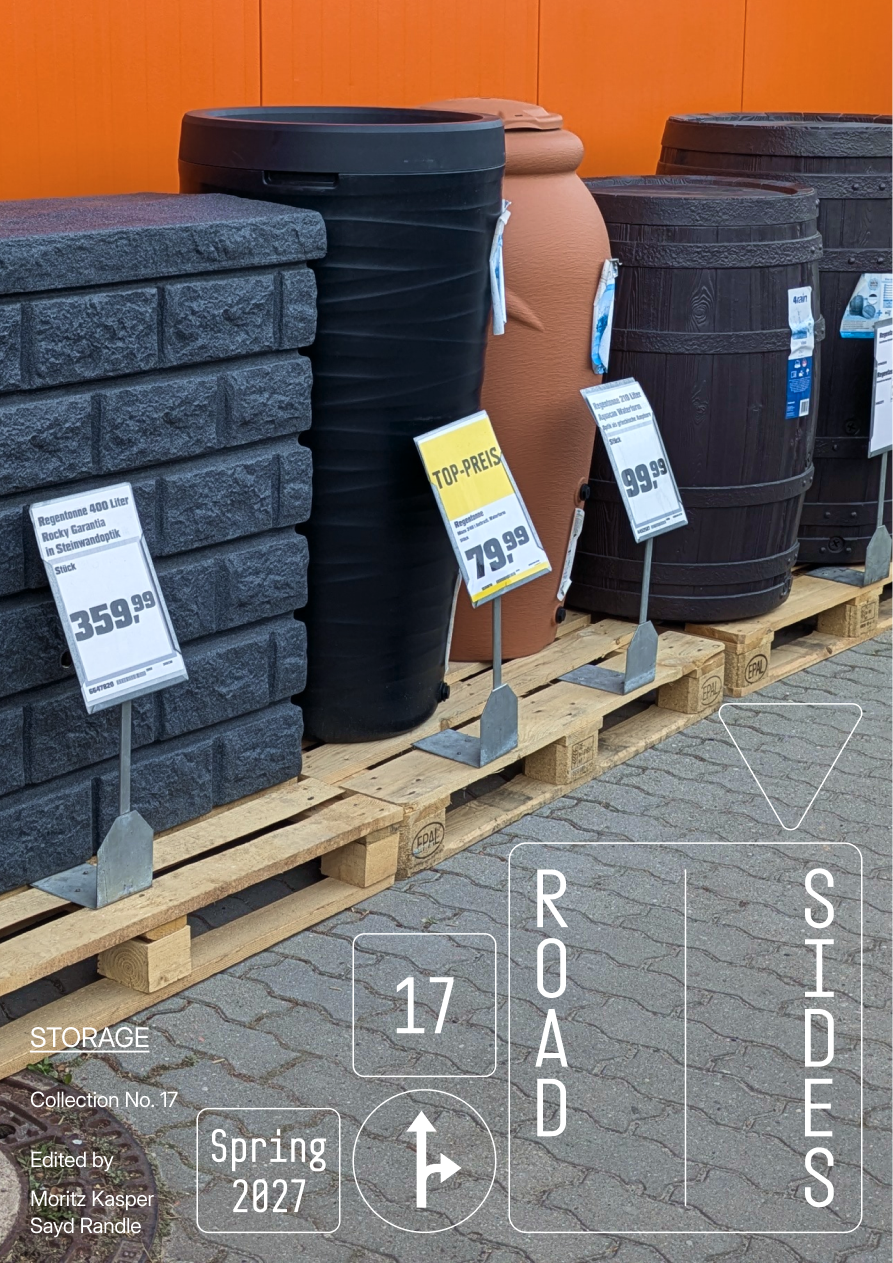
Since the beginnings of human habitation, people have been storing ‘stuff’—food, water, textiles, energy in various forms, information and more. People have stored all this in and with pots, jugs, boxes, bags, barrels, trunks, and many other artefacts and technologies of containment. After all, according to feminist author Elizabeth Fisher (1979), the very first cultural device used by humans was probably a carrier bag, itself a storage container. Through the many centuries since, an increasingly diverse array of storage implements and infrastructures has emerged, mediating resource, commodity and other flows at and across a range of scales.
In this collection, we argue for approaching storage as infrastructure and for attending to the infrastructures of storage. Our age of global circulations and on-demand delivery is made possible not only by distributive infrastructures like roads, pipelines, cables and container ships but also by all kinds of storage arrangements. Think of silos and refrigerators for our food, of jerry-cans and reservoirs for potable water, of pumped hydro and batteries for energy, of large data centres and flash drives for data. As storage temporarily suspends circulation, it captures value and capital or balances circulatory mismatches between supply and demand (Banoub and Martin 2020; Mitchell 2026). Looking at storage thus complicates flow-based perspectives, inciting critical reflection on the assumption of (material) circulation as a structuring condition of contemporary worlds.
Despite their long history and contemporary ubiquity, storage infrastructures have been relatively overlooked by scholars (but see Lewthwaite 1969; Sofia 2000), leaving much of their conceptual and empirical potential untapped. Recent work has begun to develop this perspective, approaching storage as a socio-material arrangement deeply imbricated with spatial, temporal and infrastructural politics (Braun 2025; Kasper 2025; Randle and Archer 2025). We believe that such reflection is particularly timely. Ongoing transformations—digitization and AI, ‘green’ transitions, the compounding effects of climate change and geopolitical upheavals—all serve as catalysts for the expansion of storage capacities across scales. On the one hand, major storage infrastructures become ever-more important: grid-scale batteries, green hydrogen storage, large data centres, massive water reservoirs. On the other hand, at the everyday scale we experience an individualization of infrastructural responsibilities and thus an increased emphasis on minor storage arrangements: LPG cylinders, battery-enabled solar power and all kinds of household water containers, to name a few.
Proceeding from the recognition that there is still much to explore, understand and analyse about the many storage arrangements of our infrastructural worlds, we invite contributions that consider the significance and role of storage in infrastructure across the urban–rural continuum, preferably based on empirical research. Submissions may address different notions of storage (stockpile, backup, buffer, containment, etc.), and we especially encourage visual and multi-modal contributions—such as those exploring variegated (in)visibilities or multi-scalar arrangements of storage infrastructures. To productively channel such heterogeneity, we specifically but not only welcome contributions exploring the following three threads:

Banoub, Daniel and Sarah J. Martin. 2020. “Storing Value: The Infrastructural Ecologies of Commodity Storage.” Environment and Planning D: Society and Space 38 (6): 1101–19.
Braun, Veit. 2025. “Living on Buffered Time: Toward Another Sociology of Storage.” Acta Sociologica 69 (2): 277–93.
Fisher, Elizabeth. 1979. Woman’s Creation: Sexual Evolution and the Shaping of Society. McGraw-Hill.
Kasper, Moritz. 2025. “From dams to tanks to jerry cans: Storage as a multi-scalar analytic.” Environment and Planning E: Nature and Space 8 (6): 1866–89.
Lewthwaite, Gordon. 1969. “A Plea for Storage Geography.” The Professional Geographer 21 (1): 1–4.
Mitchell, Timothy. 2026. The Alibi of Capital: How We Broke the Earth to Steal the Future on the Promise of a Better Tomorrow. Verso.
Randle, Sayd and Matthew Archer. 2025. “Political Ecologies of Storage for the 21st Century.” Antipode 57 (4): 1181–93.
Sofia, Zoe. 2000. “Container technologies.” Hypatia 15 (2): 181–201.