This is some text inside of a div block.
Search across the whole Roadsides site


What can a folk story about growing ice teach us regarding the vitality of this substance, as well as resilience and subversion in the context of climate change? In this article, I build on a folktale about the Chadar, the name given to the Zanskar River when it freezes in winter, to explore the experience of climate change in the Himalayas today. The Chadar has long been a critical infrastructure, serving as the only winter route in and out of Zanskar, a sub-region of the Ladakh Union Territory in India, when regular roads become impassable.[1] Traditionally supporting the butter trade that Zanskarpas conducted with Leh, today the Chadar is mostly linked to adventure tourism.
Since 2019, I have been collaborating on a visual project with men who work as porters, cooks and guides, collecting visual materials, interviews and stories about the frozen river. Drawing on a folktale concerning a cook and a king trapped on the Chadar, I explore how local residents of the Himalayas confront the challenges of climate change. I argue that their resilience rests on an understanding of ice as vital matter and that their actions subvert dominant forms of climate expertise.
There are many stories about the Chadar and the dangers travellers here have faced. There are also folktales of people trapped by shifting ice or avalanches. Some have known origins, while others are ancient, woven into local lore. One such recounts the story of a Zanskar king named Skyalzos.
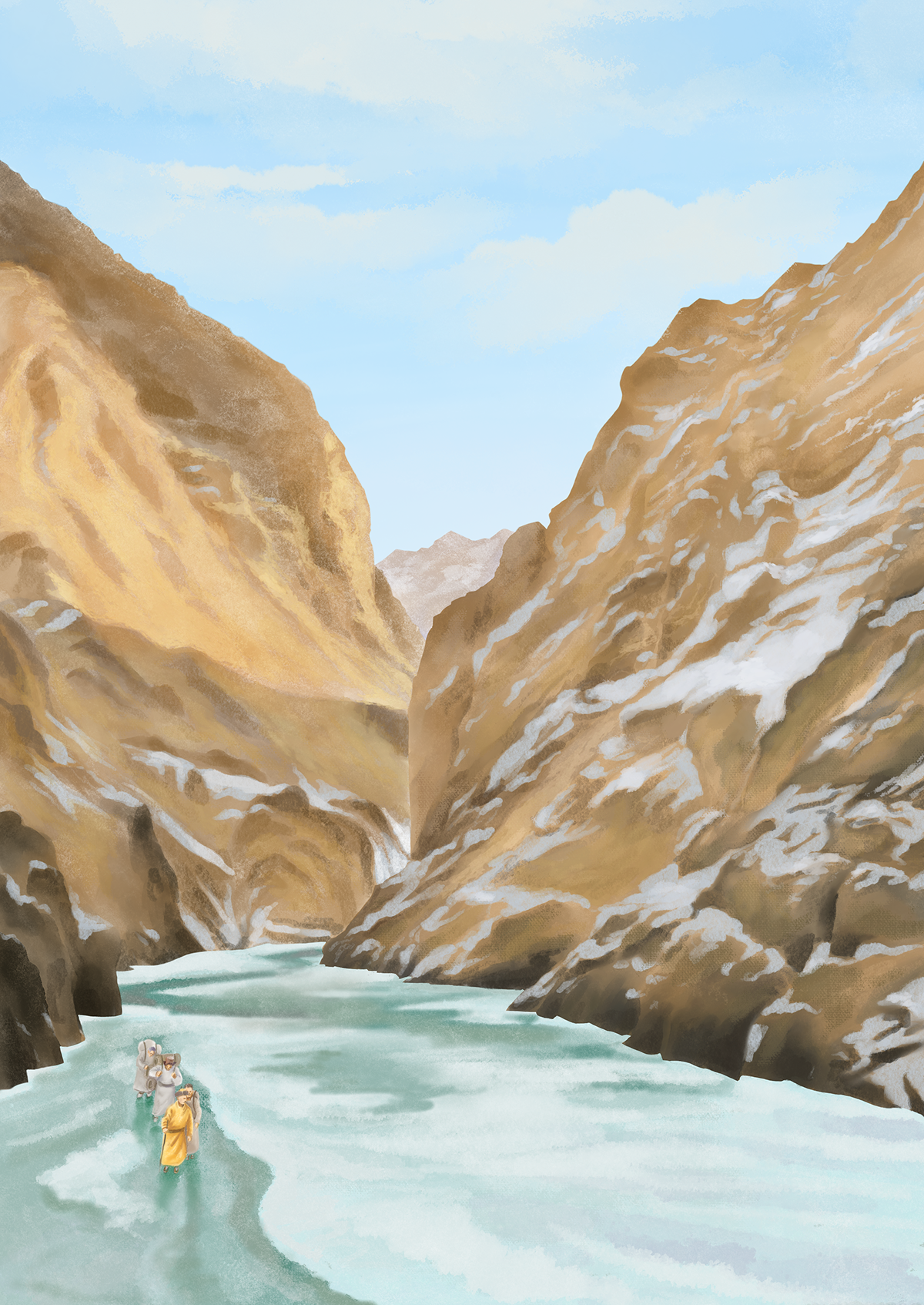
The story goes that while returning from Leh, King Skyalzos and his party—a cook and two helpers—faced a grave challenge midway through their journey. One morning, after spending the night in a cave, they awoke to find the river ice completely melted, leaving only bright blue flowing water. Trapped within the steep Zanskar gorge, their sole hope was for the temperature to drop long enough for the river to freeze again.
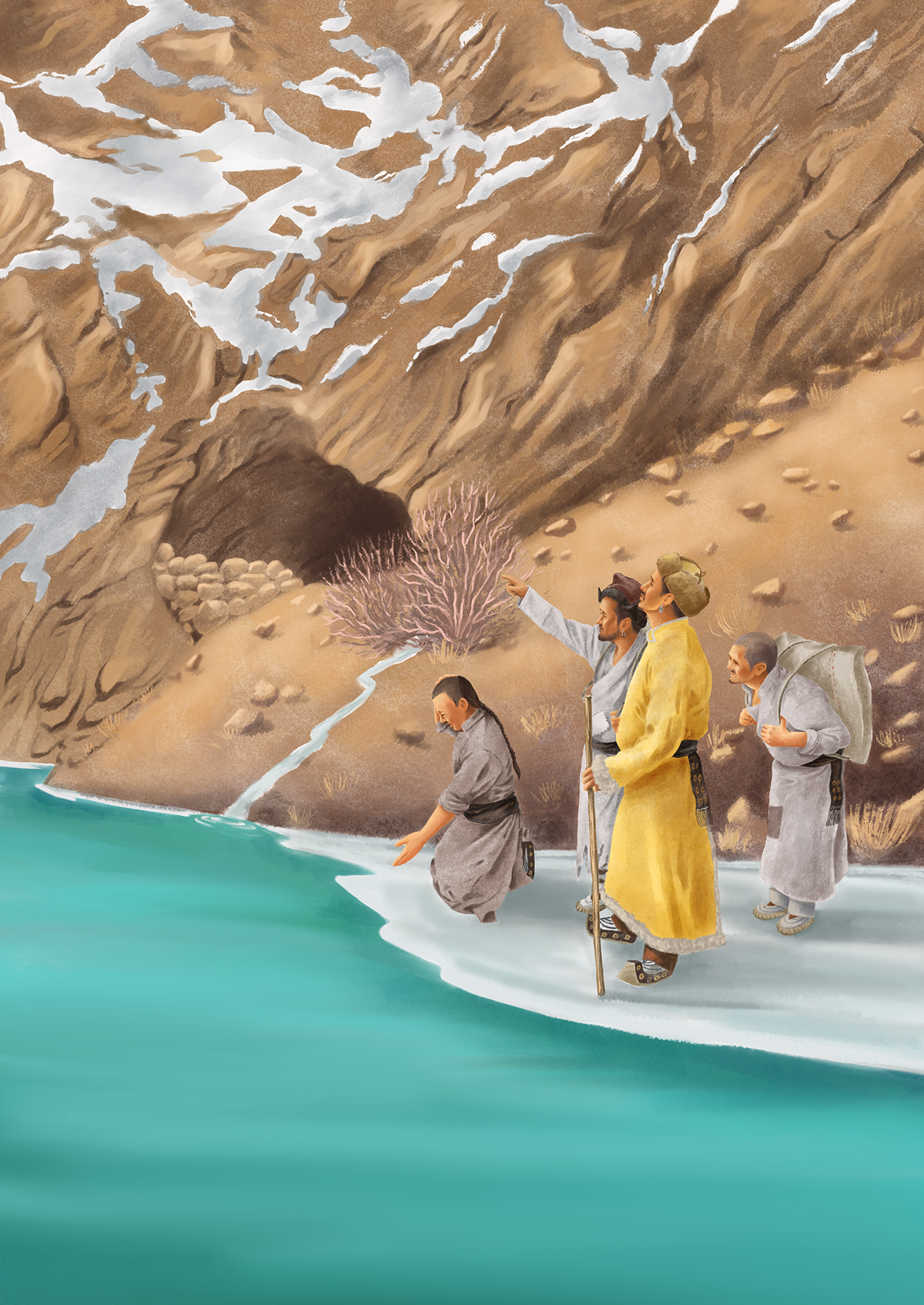
But the area was surrounded by springs, so there was a lot of warm water preventing the river from freezing. They had no choice but to wait. One day passed, then two days, then three. As time went on, they ran out of food. The cook started using what little remained—sheep and goat skins from their garments—just to keep everyone alive. It was not the tastiest meal, but it kept them going.
More days passed. Eventually, they had nothing left but water from the river. Hunger grew, and their situation seemed increasingly hopeless.
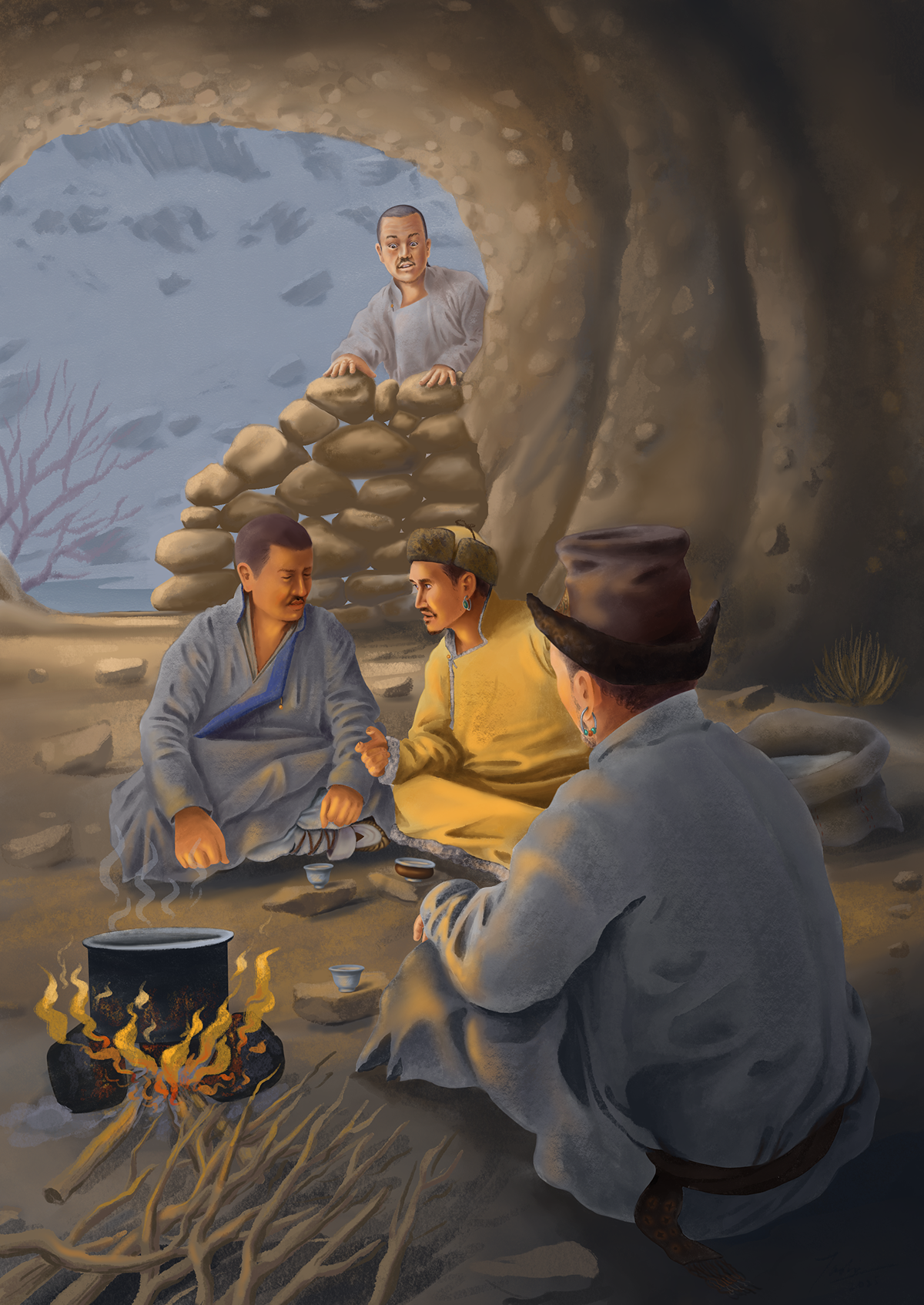
One day, while the cook was out fetching water, the king and the porters made a plan. If the ice was still not frozen the next day, they would kill the cook, just to survive. Luckily, the cook overheard them. That night, he went down to the river, prayed, and then cut a tree branch and placed it in the water. As lumps of ice floated by, they started to collect around the branch. Before he returned to the cave, he prayed again, hoping for the water to freeze so he could escape alive and see his family again.
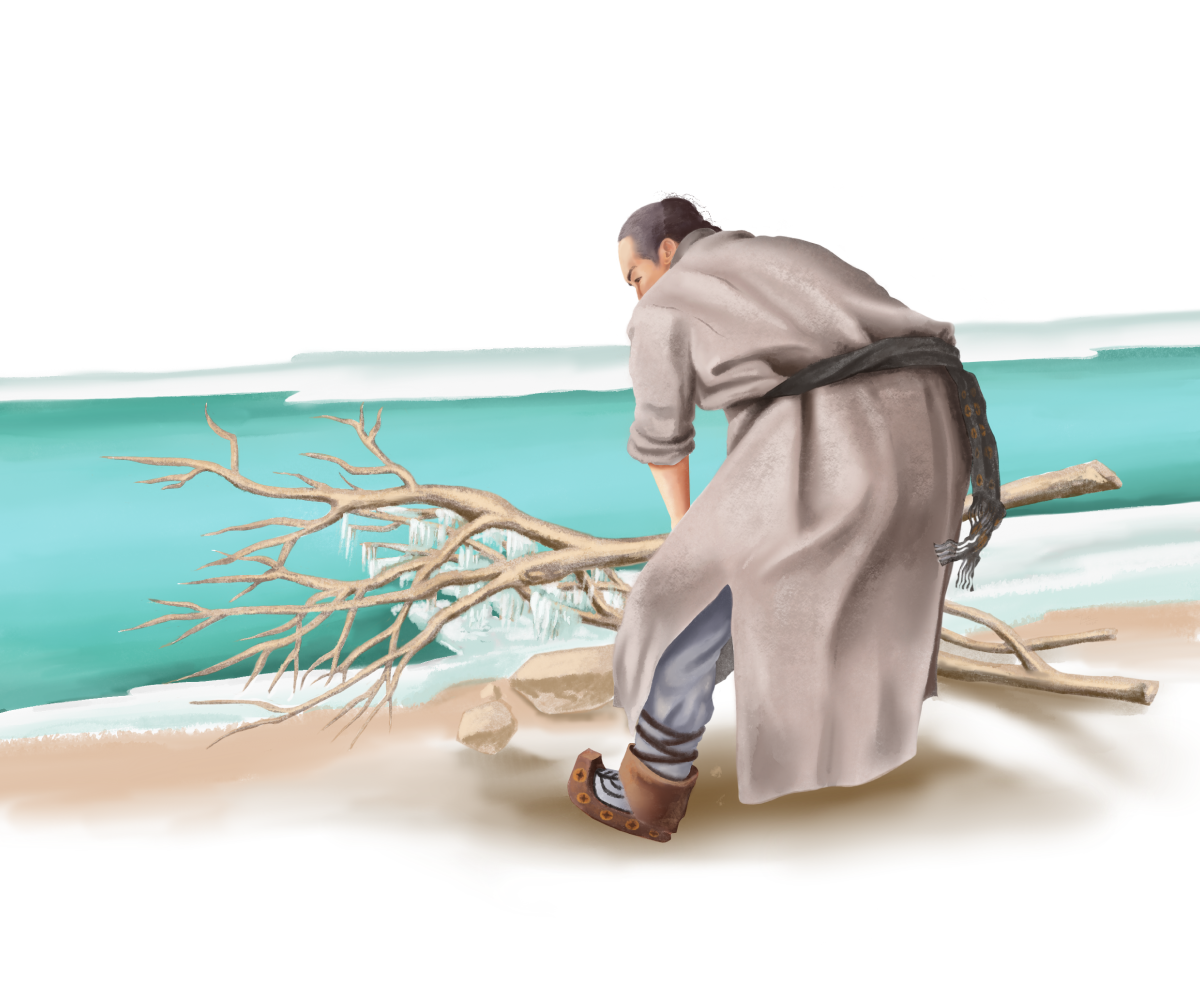
And it happened! The next morning, the river around the branch was frozen. Miraculously, the cook survived, and the king’s lineage was spared the shame of cannibalism.
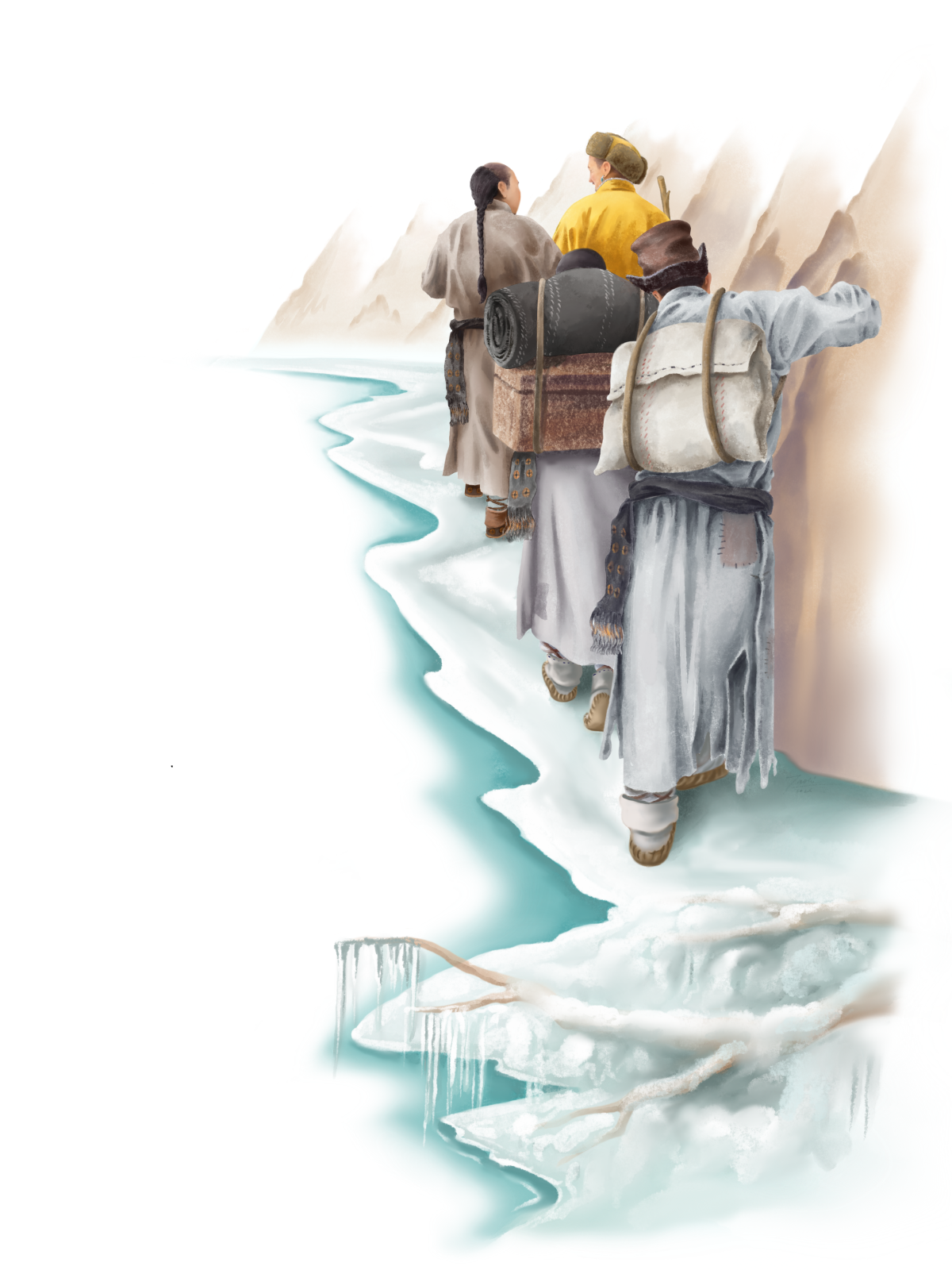
This story reveals that ice, through its materiality, is alive, capable of growth and transformation like any living being. The cook’s survival depended on attending to this liveliness, here activated through human interaction. This is not merely symbolic: on the Chadar, travellers still ‘grow’ ice by placing branches in the water, allowing it to accumulate and solidify to enable passage.
Recent scholarly attention has been drawn to the vitality of ice as matter. Traditional ideas of ice as inert are challenged by recognition of the permutations of this vitality: supporting organic life within itself (Yip 2024), existing concurrently as both solid and liquid (Simonetti 2021) and transforming into rock (Rider 2024). The vital materialism of ice is also tangible in its ontological agency, which influences both human and nonhuman bodies (Gagné 2024) and can determine human actions (Kangasluoma 2025). Overall, embracing ice’s vitality requires conceding human-centric views to appreciate how ice shapes human worlds and actions (Gagné and Drew 2024).
On the Chadar, such vitality makes ice a seasonal infrastructure that shifts with weather and climate, sometimes requiring care to maintain passage. Geographers and anthropologists have shown how nature itself can function as infrastructure—for example, Carse (2012) describes the Panama Canal’s dependence on its surrounding watershed (see also Morita 2017; Ballestero 2019). These studies highlight the interdependence of humans and nonhumans that sustain infrastructure, including the affective relations through which they become “co-emergent parts of each other’s infrastructure” (Morita 2017: 753). Reflecting on the co-emergence of people and ice—that is, how ice influences human action and how humans, in turn, may participate in its vitality—sheds light on the lessons of the Chadar folktale for understanding how residents of this region of the Himalayas navigate climate change.
When discussing the Chadar folktale with Zanskarpas, two key morals emerged. The first concerns resilience: if, like the cook, one has faith and courage, one can overcome even the toughest challenges. This raises a crucial question: could resilience to climate change be linked to how ice is seen?
In climate change research, ice is largely understood through an ontology of decay—treated as a vanishing body whose speed of melting, extent and impacts dominate both scientific and popular narratives. This focus is evident in phenomena such as glacier tourism and glacier funerals, which frame melting ice as a collective loss (Salim et al. 2026). Yet, as Dodds and Sörlin (2022: 5) note, such narratives obscure the diverse relationships that communities in ice-dominated regions maintain with ice, and also strip them of their agency. In many parts of the world, ice remains central to life, and its fluctuation is something communities continue to adapt to (Gearheard et al. 2017; Krause 2022).
In the folktale, as it melts, ice embodies both destruction and possibility: it drives people to hunger and cannibalism, yet also holds the promise of survival through creative intervention. Similarly, in my long-term work in Ladakh and Zanskar, I have never encountered expressions of despair about melting ice. While some interpret glacial retreat as signalling a changing moral order (Gagné 2019), it does not elicit fatalism. Instead, the vitality of ice is expressed through practice: Ladakhis have long harvested and cultivated ice (Gladfelter 2018) and, in recent decades, have developed artificial glaciers and other local infrastructures to address climate-induced water shortages (Mingle 2015; Clouse 2021; Celermajer 2024: 1022).
This resonates with a second moral that Zanskarpas associate with the folktale: subversion through the quiet challenging of social order. Historically, Ladakh has been a stratified society in which royal families held political and economic power and defined what counted as legitimate knowledge. The folktale reverses this hierarchy. The king appears useless, even dangerous, while the humble cook, valued mainly for practical labor, possesses life-saving knowledge.
In the context of climate change, subversion similarly takes the form of practices that invert hierarchies of knowledge and authority. Analytically, this resonates with theorization of refusal as a mode of action that does not directly confront power but sidesteps it, rendering its terms irrelevant (Simpson 2014; McGranahan 2016). Through this lens, the cook’s action is not merely an inversion of hierarchy but a refusal of the king’s authority as the sole source of legitimate knowledge. Survival emerges not from persuading power but from acting in parallel with it.
Echoes of this inversion appear in contemporary Himalayan climate adaptation. Scholars have critiqued top-down, technocratic approaches and the privileging of climate science over local knowledge (Chakraborty, Rampini and Sherpa 2023; Orlove et al. 2023; Sherpa and Puschiasis 2023). Zanskarpas’ responses reflect such critiques. In Kumik, villagers built a long irrigation canal after repeated appeals to the state went unanswered. Elsewhere, communities have constructed artificial glaciers with NGO support to address early-spring water scarcity, while in Pishu prolonged delays in a state-led canal project pushed farmers toward alternative technologies and, in 2018, to refuse state help altogether (Gagné and Chostak 2024). These practices do more than compensate for weak intervention; they withhold the state’s authority to define the terms of adaptation. Subversion here is material, enacted through practices that operate outside official frameworks.
Subversion thus exceeds resistance or critique. It lies in how Himalayan residents creatively bend the forces shaping their lives, developing locally driven responses that, like the cook’s act, often prove most consequential. In working with the vitality of ice, they enact regeneration and an understated form of resistance (Lyons 2016), offering a counternarrative to dominant tropes of loss and expert-led rescue in dystopian climate futures.
Here is a series of concepts found in the text: vitality, resilience, subversion, refusal, infrastructure, co-emergence and agency. For each concept, students must provide:
Example:
Term: Resilience
Ballestero, Andrea. 2019. “The Underground as Infrastructure? Water, Figure/Ground Reversals, and Dissolution in Sardinal.” In Infrastructure, Environment, and Life in the Anthropocene, edited by Kregg Hetherington, 17–44. Duke University Press.
Carse, Ashley. 2012. “Nature as Infrastructure: Making and Managing the Panama Canal Watershed.” Social Studies of Science 42 (4): 539–63.
Celermajer, Danielle, Maria Cardoso, Josh Gowers, Deepthi Indukuri, Pragnya Khanna, Rohit Nair, Janet Orlene, VPJ Sambhavi, David Schlosbergh, Mayank Sacha Shaw, Aadya Singh, Gijs Spoor and Genevieve Wright. 2024. “Climate Imaginaries as Praxis.” Environment and Planning E: Nature and Space 7 (3): 1015–33.
Chakraborty, Ritodhi, Costanza Rampini and Pasang Yangjee Sherpa. 2023. “Mountains of Inequality: Encountering the Politics of Climate Adaptation across the Himalaya.” Ecology and Society 28 (4).
Clouse, Carey. 2021. Climate-Adaptive Design in High Mountain Villages: Ladakh in Transition. Routledge.
Dodds, Klaus and Sverker Sörlin. 2022. “Ice Humanities: Living, Working, and Thinking in a Melting World.” In Ice Humanities: Living, Working, and Thinking in a Melting World, edited by Klaud Dodds and Sverker Sörlin, 1–33. Manchester University Press.
Gagné, Karine. 2024. “Vital Bodies: Tales of Intimate Encounters with Climate Change in Icy Ecologies.” Social Anthropology 32 (1): 13–29.
Gagné, Karine. 2019. Caring for Glaciers: Land, Animals, and Humanity in the Himalayas. University of Washington Press.
Gagné, Karine and Stanzin Chostak. 2024. “Climate Change beyond Technocracy: Citizenship and Drought Practices in the Indian Himalayas.” The Journal of Peasant Studies 51 (5): 1141–63.
Gagné, Karine and Georgina Drew. 2024. “Vital Matter: Icy Liveliness in the Anthropocene.” Social Anthropology 32 (1): 1–12.
Gearheard, Shari, Lene Kielsen Holm, Henry Huntington, Joe M. Leavitt, Andrew R. Mahoney, Margaret Opie, Toku Oshima and Joelie Sanguya (eds). 2017. The Meaning of Ice: People and Sea Ice in Three Arctic Communities. International Polar Institute Press.
Gladfelter, Sierra. 2018. Ladakh’s Artificial Glaciers, Ice Stupas, and Human-Made Ice Reserves. Fullbright Nehru Grant report. https://sierragladfelter.com/wp-content/uploads/2018/07/gladfelter_artificialglaciersofladakh_reflectionsandtakeaways_compressed.pdf
Kangasluoma, Sohvi. 2025. “The Agency of Ice in Arctic Geopolitics: An Autoethnography of the Northwest Passage.” Geoforum 166 (November): 104417.
Krause, Franz. 2022. “Inhabiting a Transforming Delta: Volatility and improvisation in the Canadian Arctic.” American Ethnologist 49 (1): 7–19.
Lyons, Kristina Marie. 2016. “Decomposition as Life Politics: Soils, Selva, and Small Farmers under the Gun of the U.S.–Colombia War on Drugs.” Cultural Anthropology 31 (1): 56–81.
McGranahan, Carole. 2016. “Theorizing refusal: An introduction.” Cultural Anthropology 31 (3): 319–25.
Mingle, Jonathan. 2015. Fire and Ice: Soot, Solidarity, and Survival on the Roof of the World. St Martin’s Publishing Group.
Morita, Atsuro. 2017. “Multispecies Infrastructure: Infrastructural Inversion and Involutionary Entanglements in the Chao Phraya Delta, Thailand.” Ethnos 82 (4): 738–57.
Orlove, Ben, Pasang Sherpa, Neil Dawson, Ibidun Adelekan, Wilfredo Alangui, Rosario Carmona, Deborah Coen, Melissa K. Nelson, Victoria Reyes-García, Jennifer Rubis, Gideon Sanago and Andrew Wilson. 2023. “Placing Diverse Knowledge Systems at the Core of Transformative Climate Research.” Ambio 52 (9): 1431–47.
Rider, Alexis. 2024. “Of Ice and Meteorites: Geologic Glitches and Temporal Viscosity in the Antarctic Ice Sheet.” Social Anthropology 32 (1): 46–63.
Salim, Emmanuel, Alix Varnajot, Mark Carey, Karine Gagné, Gijsbert Hoogendoorn, Cymene Howe, Matthias Huss, Christopher Lemieux and Emma Stewart. 2026. “Melting Icons: Glaciers as Symbols of Climate Change and Tourism Paradoxes.” Nature Climate Change 16 (2): 106–108.
Sherpa, Pasang Yangjee and Ornella Puschiasis. 2023. “A Reflexive Approach to Climate Change Engagement with Sherpas from Khumbu and Pharak in Northeastern Nepal (Mount Everest Region).” In Anthropology and Climate Change: From Transformations to Worldmaking, edited by Susan A. Crate and Mark Nuttall, 224–41. Routledge.
Simonetti, Cristián. 2022. “Viscosity in Matter, Life and Sociality: The Case of Glacial Ice.” Theory, Culture & Society 39 (2): 111–30.
Simpson, Audra. 2014. Mohawk Interruptus: Political Life Across the Borders of Settler States. Duke University Press.
Yip, Julianne. 2024. “Chasing Rotten Ice: A Vitalist Ethos in Scientific Encounters with Sea Ice ‘Itself’.” Social Anthropology 32 (1): 64–79.